
The Password Was Her Name !
PART 1:
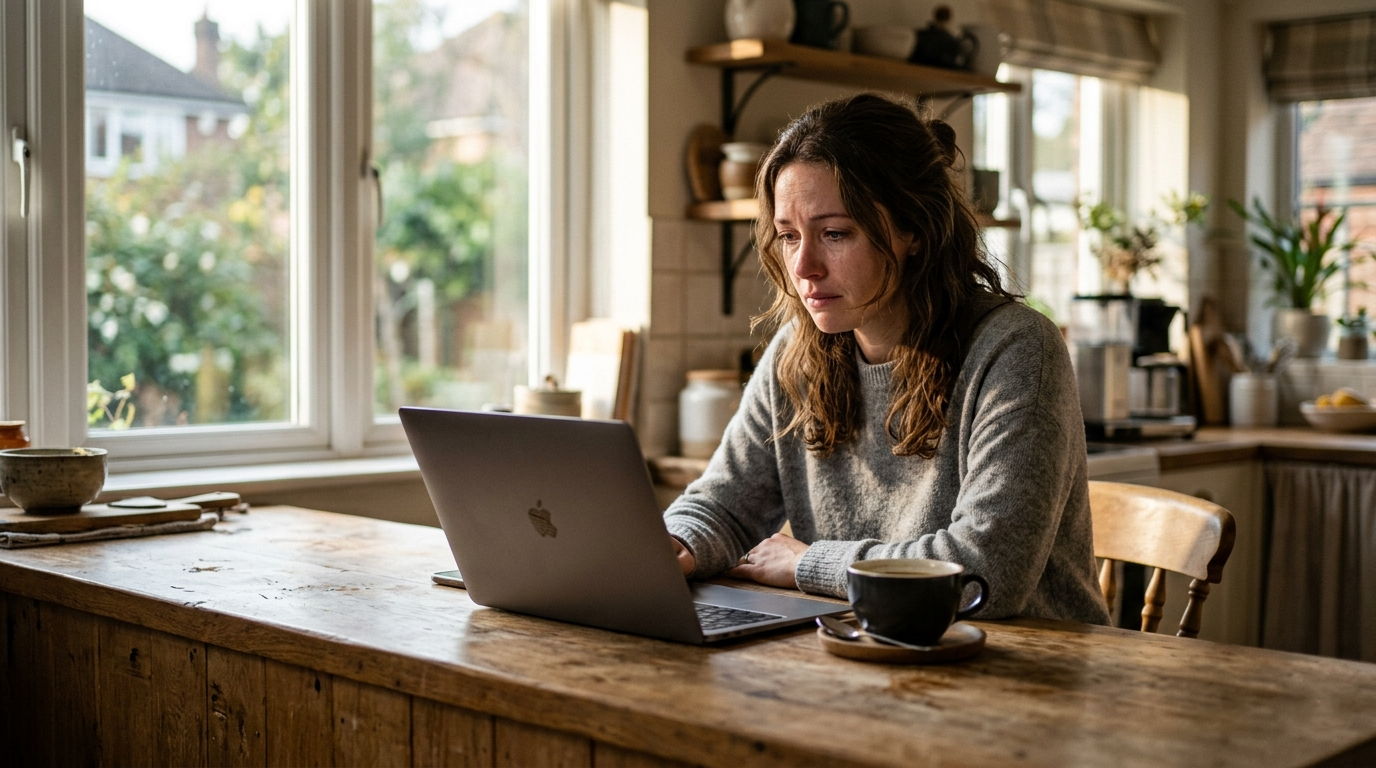
I wasn’t snooping. I want to be clear about that — not because it would matter if I had been, but because the truth is more ordinary and therefore more devastating than snooping. I was trying to pay a bill. Our joint laptop had died the week before and the replacement hadn’t arrived yet, and I needed to log into our bank account and the only device available was Garrett’s personal laptop, which he had left on the kitchen counter that morning before his flight to Atlanta. He had told me the password was the same as always — his childhood street name and the year we got married. He had told me this without hesitation, the way you tell someone something you have nothing to hide about.
It wasn’t that password anymore. I tried it twice. Locked out for sixty seconds. Tried it again. Wrong.
I sat there for a moment looking at the screen. Then I tried his mother’s maiden name. Wrong. His college team. Wrong. Our dog’s name. Wrong.
I don’t know what made me try it. I will never be able to explain the sequence of thought — if it was thought at all and not something more instinctive, some accumulation of small unexamined things finally arriving at a surface conclusion. I typed a name. Seven letters. A name I had heard exactly once, four months ago, mentioned briefly and then smoothed over with such practiced ease that I had filed it without opening it.
The laptop opened.
I sat at the kitchen counter for a very long time without moving. The bill I needed to pay was still waiting. The bank tab was open in the browser. And I understood, with the absolute clarity of someone who has just been handed an answer to a question they didn’t know they were asking, exactly what the password meant.
You don’t change your password to someone’s name by accident. You don’t do it absentmindedly, or for convenience, or because it’s easy to remember. You do it because the name is in your mind constantly — because it is the word your fingers reach for first, because it lives in that particular part of you where only the most important things reside.
Garrett had changed his password to her name. And she — Lauren, seven letters, a woman I had met once at a work function and shaken hands with and smiled at and thought nothing of — had been living in the most instinctive part of my husband’s mind while I was at home paying bills and cooking dinners and sleeping beside him in our bed.
“I paid the bill. I know that sounds strange — that in the middle of realizing my marriage might be built on something I couldn’t see, I completed the task I had sat down to do. But that is who I am. I finish what I start. I was about to find out just how true that was.”
I closed the browser. I did not go through the laptop. Not the emails, not the messages, not any of it. Not because I was above it — I had just learned that I was capable of trying seven passwords without flinching, so I was clearly past the point of pretending I was above anything — but because I had decided, sitting at that counter, that I did not want information gathered in panic. I wanted the truth, gathered carefully, with enough steadiness that I could do something real with it.
Garrett came home from Atlanta on a Thursday. He kissed me hello. He asked about my week. He poured himself a drink and told me about the conference and a dinner he’d had with colleagues, and I listened and responded and gave him nothing, the way you hold a card close when the game actually matters.
I already knew what I was going to do. I had known since the moment that laptop opened. I just needed four more days to do it properly.
What I found in those four days was so much larger than a password. It was an entire architecture — careful, maintained, running quietly alongside our marriage like a second household that I had been financing without knowing it.
And what I did with what I found changed not just my marriage but something I had believed about myself for thirty-six years.
· · ·
Seven letters. One name. One unlocked screen.
That was all it took to unravel five years — and to finally, completely, set me free.
PART 2:
Seven Letters — and Everything They Unlocked
My name is Vivian. I am a thirty-six-year-old occupational therapist who works with stroke patients at a rehabilitation center in Charlotte, North Carolina. I say this because it is relevant — not to establish credentials but to explain something about how I think. My entire professional life is built around the careful, patient reconstruction of function. Around looking at what is broken and determining, methodically and without sentiment, what can be restored and what needs to be rebuilt entirely from scratch. I am very good at it. I had simply never applied it to my own life until a Tuesday morning with an unpaid bill and a laptop that opened on the first try.
The four days between the password and the confrontation were the most focused days of my life. I did not hire anyone. I did not go through Garrett’s phone — I had made a decision about gathered-in-panic information and I kept it. What I did was simpler and more devastating: I paid attention. I paid the kind of attention I had apparently not been paying for some time, and it turned out that when you actually look, the evidence of a hidden life is not hidden nearly as carefully as the person living it believes.
Lauren worked in Garrett’s company’s Dallas office. I confirmed this through the company website, which was public, which required nothing more than a search and thirty seconds of reading. Her photo was there — professional headshot, dark hair, the composed expression of a woman who is good at her job. I looked at it for a moment and then closed the tab, because I had what I needed from it and looking longer would have only served the part of me that wanted to feel things rather than the part that needed to act.
The Atlanta conference Garrett had just returned from — I looked it up. It was real. It was also, I discovered through the conference website’s attendee list, a conference that Lauren’s division had also sent representatives to. I did not know for certain that she had been one of them. I did not need to know for certain. The pattern was sufficient.
“There is a particular kind of intelligence that grief sharpens in you. Not cleverness — something older than that. The intelligence of a person who has been made to pay very close attention to something they would have preferred not to know, and who finds, in the paying of that attention, a precision they didn’t know they possessed.”
On the third day I called my sister Margot, who lives in Raleigh and who has the great gift of listening without editorializing. I told her everything — the bill, the password, the four days, Lauren’s name on a conference website. She was quiet for a long moment and then she said: “What do you need from me right now?” Not what she thought I should do. Not her opinion of Garrett or of the situation. Just: what do you need. I told her I needed a recommendation for a good family attorney in Charlotte. She had one within the hour.
I called the attorney — a woman named Patricia Howe who had a calm, direct phone manner that immediately made me feel I was in capable hands — and made an appointment for the following week. I said I was gathering information and wasn’t certain yet what I was dealing with but wanted to understand my options before I knew more. She said that was exactly the right order of operations. I felt, for the first time in four days, that someone was confirming I was doing this correctly.
Garrett came home on Thursday evening and I was in the kitchen making dinner and we ate together and talked about ordinary things and I watched him across the table — this man I had been married to for five years, this man whose laptop opened to another woman’s name — and I thought: I know you. I have always known you better than you realized. That is the thing about living closely with someone. You absorb them. Their rhythms, their tells, the specific way their eyes move when they are managing information. I had absorbed all of it without cataloguing it, and now I was cataloguing it, and what I saw across the dinner table was a man who was performing ease with considerable effort.
He was not as relaxed as he appeared. I had simply been too trusting, for too long, to notice the difference.
On Saturday morning I asked him to sit down.
I had thought carefully about how to do this. Not the words exactly — I have never been someone who scripts conversations, because real conversations don’t follow scripts and the attempt to make them do so only produces a performance instead of a truth. But the shape of it. The order. What I needed to say and what I needed to hear and what would happen after.
“I need to ask you something,” I said. “And I need you to answer me honestly. Not the managed version. The actual truth.”
He looked at me with an expression I recognized as the beginning of careful. “Okay,” he said.
“Who is Lauren?”
The careful expression lasted exactly two more seconds. Then it gave way to something underneath — not guilt exactly, more like the specific exhaustion of someone who has been holding something heavy for a long time and has just been told they can put it down. He looked, in that moment, genuinely relieved. Which told me everything about how long this had been going on and how much of his energy it had been consuming.
He told me. It had been going on for eight months, beginning at a company summit in the spring. It was not, he said — and I believed him, for reasons I could feel rather than explain — something he had planned or pursued. It was something that had happened and then continued happening because he had not been strong enough to stop it and had not been honest enough to tell me and had been living in the particular private hell of a person who is betraying someone they genuinely love and knows it and cannot seem to choose differently.
I let him finish. Then I said two things.
The first: “I know about Atlanta.”
The second: “I’ve already called an attorney.”
“He didn’t argue. He didn’t try to negotiate or minimize or ask for another chance. He just nodded, slowly, like a man receiving a consequence he had always known was coming and had perhaps, on some level, been waiting for. That nod told me more about the state of our marriage than anything else he said that morning.”
He moved out two weeks later. The process was not without pain — five years of shared life does not unwind cleanly regardless of the circumstances, and there were moments of grief that arrived unexpectedly and stayed longer than I would have chosen. A Saturday morning in February when I made coffee for two by habit and stood at the counter with both cups before I remembered. A Sunday when I drove past the restaurant where we had our first date and felt the loss of it so sharply I had to sit in a parking lot for ten minutes before I could drive again.
I let those moments be what they were. I did not rush them or minimize them or tell myself I shouldn’t feel them because he had been the one to betray. Grief does not follow the logic of fault. It follows the logic of love — and I had loved him, genuinely, and that love deserved to be properly mourned even if the marriage did not deserve to be saved.
Patricia Howe was exceptional. The divorce was finalized in seven months. I kept the house, which was in my name from before the marriage. I kept the dog — our golden retriever, Biscuit, who had always preferred me and made no secret of it. I kept, most importantly, the clarity that had arrived on a Tuesday morning at a kitchen counter and had not left since.
I have thought often about the password. About what it means that he chose her name — not randomly, not carelessly, but as the word his hands reached for automatically in a private moment. I have made peace with what it means. Not because it doesn’t hurt, but because understanding it fully — understanding that he had given a significant piece of himself to someone else long before I found out — made it easier to accept that what I was losing at the end was not a whole marriage but the remainder of one. The whole version had been gone for some time. I had just not had the key.
And now, nine months later, I have something I did not have before: the complete, unedited truth of my own life. Every room of it. Every corner. No more closed tabs, no more smoothed-over names, no more passwords I haven’t been given.
I changed the passwords on everything the week Garrett moved out. Every account, every device, every digital door that had ever been shared between us. I chose them carefully — not someone’s name, not a significant date. Just long, random strings of characters that mean nothing to anyone but me.
Private. Secure. Entirely mine.
That is how I know they will stay that way.
Some lessons, once learned at the right cost, never need to be learned again.
— End of Story —