He Cried at Our Wedding. I Now Know Why.
PART 1:
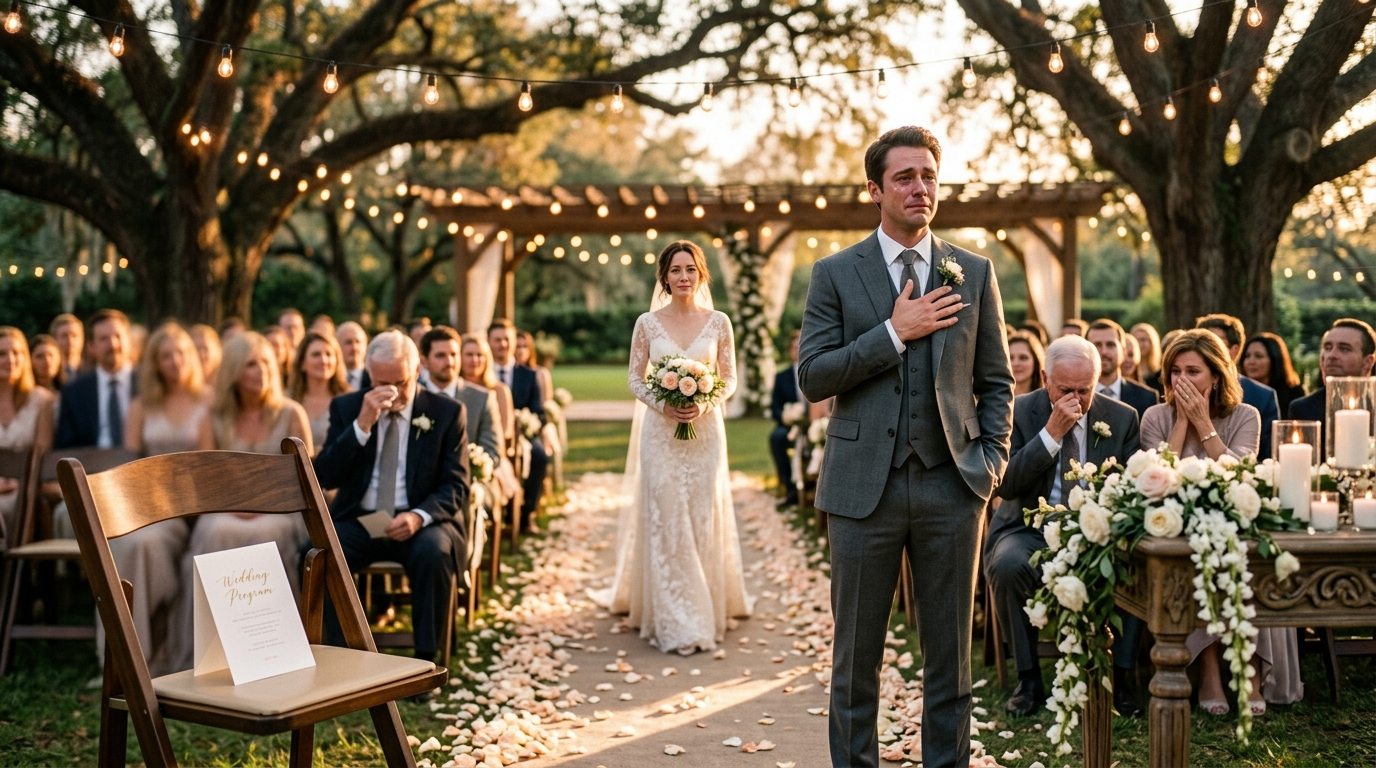
Every woman at the ceremony commented on it. My mother, dabbing her own eyes, whispered that it was the most romantic thing she had ever seen. My bridesmaids squeezed each other’s arms. Three women I barely knew came up to me at the reception and said some version of the same thing — that a man who cries at his own wedding is a man who truly means it, and that I was the luckiest woman in the room.
I believed them. Of course I believed them. I was standing at the altar in a dress I had spent eight months choosing, marrying a man who was wiping tears from his face as I walked toward him, and every single person in that room was reflecting the same story back at me — that this was real, that this was the good kind, that this was a man completely undone by the sight of the woman he loved.
I have thought about those tears every day for the past six months. I have turned them over and over in my mind like a stone you keep expecting to find a different shape. And I have arrived, slowly and then all at once, at an understanding that has rewritten everything I thought I knew about the day I considered the happiest of my life.
His name is Joel. We met four years ago at a mutual friend’s barbecue in Savannah. He was funny and warm and paid attention in the way that feels rare — the way where you realize halfway through a conversation that someone has been listening to everything, not just waiting for their turn to speak. We dated for two years. We were engaged for one. The wedding was last June, a Saturday, outdoor ceremony under string lights on my parents’ property, two hundred guests, everything I had ever pictured.
The first year of marriage felt, from the inside, like a good one. There were adjustments — there always are — but nothing that alarmed me, nothing I couldn’t file under the normal friction of two lives becoming one. Joel worked long hours at his architecture firm. I taught second grade and came home tired in the particular bone-deep way of people who spend their days managing the emotional lives of seven-year-olds. We were busy. We were tired. We were, I told myself, a normal married couple in their first year.
The cracks, when I look back now, were always there. I simply did not know what I was looking at.
Joel had a college friend named Patrick who came to visit twice a year — once in the spring, once in the fall — and whose visits Joel looked forward to with an enthusiasm that was slightly different in quality from how he looked forward to other things. Not more intense, exactly. Just more present. More himself, in some way I couldn’t locate precisely but always noticed and always filed away without examining.
“I liked Patrick. That was the thing that made it so impossible to examine — he was kind, funny, easy to be around, and the three of us always had a genuinely good time together. There was nothing to point at. Nothing to name. Just a feeling, quiet and persistent, that I was sometimes a guest in a room that had been full long before I arrived.”
Six months ago, on a Thursday evening in March, I came home from a particularly difficult day at school to find Joel sitting at the kitchen table with his hands folded in front of him and an expression I had never seen on his face. Not guilt — something older than guilt. Something that looked, I would understand later, like a man who has been carrying something for a very long time and has finally decided that putting it down is worth whatever comes next.
“I need to tell you something,” he said. “And I need you to know that everything I am about to say is the truest thing I have ever said to you. Including things I should have said much sooner.”
I sat down. I put my bag on the floor. I looked at my husband across our kitchen table and I felt, in the space before he spoke, the specific stillness of a person who understands they are about to step from one version of their life into another.
What he told me that night answered a question I hadn’t known I was asking. It explained the tears at the altar — not as performance, not as deception, but as something far more complicated and far more human than either of those things.
And it changed not just my marriage but my understanding of love itself.
· · ·
He spoke for almost an hour. I did not interrupt once.
By the time he finished, everything I thought I knew about our wedding day — about those tears, about that altar, about the man I had married — looked completely different. Not smaller. Just true, finally, in a way it had never quite been before.
PART 2:
What He Said — and What We Did With It
Joel told me he was gay. He had known since he was nineteen. He had spent seventeen years managing that knowledge — not denying it exactly, but containing it, routing his life around it the way water routes around an obstruction, finding the path of least resistance which, for Joel, had meant a life that looked from the outside like the one everyone expected of him. Good career. Good friends. Good woman. Good wedding with two hundred guests and string lights and tears at the altar that every woman in attendance called the most romantic thing they had ever seen.
He and Patrick had been in love since college. I understood this without him having to say it directly — I understood it the moment he mentioned Patrick’s name in the second sentence, and everything I had ever filed away without examining came forward at once, quiet and orderly, arranging itself into the shape of something that had always been true.
I sat across from him for a long time after he stopped speaking. The kitchen was very quiet. The dinner I had been planning to make was still in the refrigerator. The bag I had dropped on the floor when I sat down was still there, leaning against the chair leg, and for some reason I kept looking at it — a small, ordinary object that had no idea what room it was in.
Finally I said: “The tears. At the altar. Tell me about the tears.”
He was quiet for a moment. Then he said: “I was crying because I loved you. Because you were walking toward me and you were so happy and you deserved every bit of that happiness and I knew — standing there — that I was not going to be able to give you the life you thought you were walking into. And I did not know how to stop it. And I did not know how to tell you. And so I cried, because it was the only honest thing I could do in that moment.”
“I have turned that answer over in my mind every day since. It is the saddest thing anyone has ever said to me. It is also, I have come to believe, one of the most loving — because it means that even in the middle of his own impossible situation, what he felt most was grief for me. And that grief was real, even when nothing else was what I thought.”
I did not scream. I did not throw anything. I did not perform the anger I think I was expected to feel — not because I didn’t feel it, but because the anger, when it arrived, was quieter and more complicated than screaming. It was the anger of someone who looks back over four years of small unexamined feelings and understands that she was not wrong, was never wrong, had simply been loving someone who could not fully receive it. That kind of anger doesn’t have an obvious target. It just sits with you, heavy and patient, until you decide what to do with its weight.
I asked him one practical question that night: “What do you need from me right now?” Not what I needed — I couldn’t locate that yet. But I could locate the question, and asking it was something to do with my hands while the rest of me caught up.
He said he needed me to know that he was sorry. That he had loved me as completely as he was capable of loving anyone, which he understood was not the same as the love I deserved but was, for him, real and genuine and not a performance. He said he had been trying, for years, to be the person he had promised everyone he would be, and that the trying had cost both of us something he couldn’t give back.
I believed him. That was the thing I kept returning to in the weeks that followed — I believed him. Not about everything, not immediately, but about the core of it: that he had not married me cynically or carelessly. He had married me as an act of hope — hope that love, in the form he was capable of, would be sufficient. It wasn’t. But the hope had been real. And real hope, even misplaced, is different from deliberate deception.
That distinction mattered to me. I needed it to matter, because without it the entire four years collapsed into something I couldn’t hold — couldn’t extract a single real thing from. With it, I could keep what had been true — the laughter, the ordinary tenderness, the specific way he knew how to make me feel heard — while understanding that the structure around those true things had been built on something that could not hold weight indefinitely.
My sister was the first person I told. She drove from Atlanta the following Saturday and we sat on my back porch for six hours and she asked every question she needed to ask and I answered every one of them as honestly as I could, and somewhere in hour four she took my hand and said: “How are you, underneath all the explaining?” And I had to think about that for a long time before I could answer.
Underneath all the explaining, I was grief-stricken and strangely calm in equal measure. The grief was for the marriage I had believed I was in — for the specific future I had been picturing, the children we had talked about, the growing-old-together I had considered as settled as the weather. The calm was harder to account for, until my therapist helped me name it: it was the calm of someone who has finally been given the true map of the territory she has been navigating. The terrain had not changed. It had always been what it was. I simply had better information now, and better information, however painful, is always preferable to a beautiful lie.
Joel moved out in April. We were kind to each other in the moving — more kind, perhaps, than most divorcing couples, because we both understood that what had broken between us was not love but circumstance, and that kindness was the only currency either of us had left to offer. He took the furniture he had brought into the marriage. I kept everything else. We divided the joint account without argument, because neither of us had the energy for argument and both of us had more important things to rebuild.
Patrick, I heard through Joel several months later, had also recently ended a long relationship. I did not ask for more details. That story belongs to them and I am not its narrator.
I filed for divorce in May. It was finalized in September. My attorney was efficient and my documents were in order and the whole process was, compared to the marriage itself, remarkably straightforward. The law has a clear procedure for the ending of things, which I found, in that season, genuinely comforting. Some things, at least, follow a knowable sequence.
“People ask me if I hate him. I tell them no, and they look skeptical — as if no is the answer someone gives when they haven’t processed things fully yet, when the real answer is still on its way. But no is the true answer. I don’t hate Joel. I grieve what we were and what we couldn’t be. Those are different things.”
I went back to teaching in September with a quietness in me that my students, with the unnerving perceptiveness of seven-year-olds, immediately noticed. One of them — a small, serious boy named Owen who had been in my class since August — came up to my desk on the third day of school and said, with complete gravity: “Miss Ellie, you seem like you had a hard summer.” I told him he was very observant. He nodded like this was expected and went back to his seat.
I thought about Owen for days afterward. About how clearly children see the things adults have learned to look past. About how much of our lives we spend developing the skill of not-seeing, of smoothing over, of accepting the surface because examining beneath it costs too much. I had spent four years not-seeing. I was done with that particular skill. I was learning, slowly and with some difficulty, to look directly at things — to let them be what they were without immediately finding a more comfortable version.
It is harder than it sounds. It is also the only way I know how to live now.
Last month I had dinner with a friend I hadn’t seen since before the wedding. She asked, carefully, how I was doing. I told her the truth — not all of it, not the two-hour version, but the honest summary: that I was sad and clear-eyed and learning to distinguish between the two, and that most days the clear-eyed part was winning.
She said: “Do you think you’ll trust someone again? Fully, I mean. The way you trusted Joel.”
I thought about that for a moment. Then I said: “I think I’ll trust differently. Not less — differently. I’ll trust what I can see as well as what I feel. I’ll trust the full picture, not just the part that’s being shown to me.” I paused. “And I’ll pay attention to the things I keep filing away without opening. I think that’s where the truth usually lives.”
She nodded. We ordered dessert. We talked about other things.
On the way home I thought about the wedding. About the string lights and the two hundred guests and my mother whispering that it was the most romantic thing she had ever seen. About Joel standing at the altar with tears on his face as I walked toward him.
I understand those tears now. I carry them differently than I used to. Not as a wound — as a complexity. As the image of a man who loved me in the way he was capable of and grieved, in real time, at the altar of his own wedding, the gap between what he could give and what I deserved.
That grief was his most honest moment. And understanding it — truly, fully understanding it — is, strangely, the most at peace I have felt with any of it.
He cried at our wedding.
Now I know why.
And knowing — even this, even something this hard to hold — is always better than not knowing.
I am certain of that now in a way I have never been certain of anything.
— End of Story —