My Husband Disappeared for 3 Days. The Voicemail He Left Explained Everything.
PART 1:
The morning Daniel didn’t come home, I told myself there was a reasonable explanation.
He was a contractor. He worked long hours, took on jobs in neighboring counties, sometimes lost track of time when a project ran over. We had been married nine years. I knew his rhythms the way you know the sounds of your own house — which floorboards creak, which faucet drips, what silence sounds like when it’s comfortable versus when something is wrong.
By 11 p.m., the silence was wrong.
I called his cell. Voicemail. I called it eleven more times before I stopped counting. I texted his foreman, his best friend since high school, his younger brother in Cincinnati. I drove, at midnight, to the job site he’d been working that week — a kitchen renovation in a neighborhood twenty minutes from ours — and sat in the dark parking lot of the strip mall across the street, watching a building where no lights were on and no truck was parked, feeling the specific cold of a person who understands they are looking for something they are not going to find.
I drove home. I sat on the edge of our bed. I did not sleep.
By the second morning, I had filed a missing persons report. The officer who took my statement was kind in the careful, practiced way of someone who has delivered difficult news before and is not certain yet whether this will be another one of those times. He asked all the questions you’d expect — had Daniel seemed distressed lately, had we argued, were there financial problems, did he have any history of depression. I answered each one and heard, underneath the questions, the shape of what he was actually asking: Is there a reason your husband might have chosen to leave?
I said no. I believed that. I still believe it, though not in the way I believed it then.
On the third morning, at 6:47 a.m., my phone lit up with a voicemail from a number I didn’t recognize.
It was Daniel’s voice.
He spoke for four minutes and thirty-eight seconds. I have listened to that voicemail — I am not exaggerating — close to two hundred times since that morning. I have it memorized the way you memorize something not because you chose to study it but because your mind, on its own, kept returning to it until the words became permanent.
What he said explained everything.
It also changed everything — our marriage, our home, our plans, the entire shape of the future I thought I had already mapped out.
I want to tell you what was in that voicemail. I want to tell you what happened after. I want to tell you how we got from that kitchen-floor morning, me in yesterday’s clothes with my phone pressed to my ear, to where we are right now — which is a place I could not have imagined then and would not trade for anything now.
The full story is on the website. It is long, and honest, and I have not left out the hard parts.
Start reading below. I think it will stay with you.
— Mara
PART 2:
What Was in the Voicemail — and What We Did Next
I want to go back to the beginning, because the beginning matters.
Daniel and I met at a Fourth of July party in 2014 at a friend’s lake house outside of Nashville. He was thirty-two. I was twenty-nine. He was standing near the water with a paper plate of food he wasn’t eating, talking to nobody, watching the boats go by with the expression of a man who had agreed to be somewhere and was now quietly renegotiating the terms with himself. I found that expression immediately recognizable. I was doing the same thing on the opposite side of the dock.
We talked for three hours that night. We exchanged numbers. We had dinner the following Thursday and did not stop seeing each other after that. He was steady and dry-humored and paid attention in the quiet, non-performative way that I have always found more compelling than any grand gesture — the kind of attention that means someone has actually been listening, not just waiting.
There were things about his past he didn’t talk about much. I knew his parents had divorced when he was twelve, that he had a complicated relationship with his father, that there had been a period in his mid-twenties — before Nashville, before contracting, before the version of himself I had met — that he referred to only as a rough few years and did not elaborate on. I did not push. I had my own closed rooms. We were two people who had found steadiness in each other after spending time in unsteady places, and we understood, without discussing it explicitly, that some doors stayed shut until you were ready to open them yourself.
We got married in the fall of 2015. Small ceremony, backyard of his aunt’s property in Franklin, Tennessee. Forty guests. His father was not there. That was the only moment in the entire day that I watched Daniel’s face go somewhere I couldn’t follow — a brief, controlled distance, there and then gone, the way weather moves across open water.
I filed it. I did not open it.
For nine years, we built something I was genuinely proud of. We bought a house. We talked, seriously and often, about children — it had not happened yet, not for any one specific reason but for the accumulation of small reasons that tend to cluster in your thirties: timing, finances, a miscarriage in 2019 that we grieved privately and thoroughly and did not talk about with most people. We had good years and hard years and years that were both, threaded together. By last spring, I would have described our marriage as settled — not in a diminished way, but in the way of something that has been tested and held.
Which is why the disappearance did not make sense. Not for the Daniel I knew.
The voicemail came at 6:47 on a Wednesday morning — the third day he’d been gone.
I was sitting on the kitchen floor. I had started sitting on the floor sometime in the second day, without making a decision to do so, the way you sometimes find yourself somewhere and realize your body got there before your mind did. I had a cup of coffee that had gone cold. I had called both of our families the night before. His brother Marcus had driven up from Cincinnati and was asleep on our couch. The missing persons detective had checked in twice.
When my phone lit up with the unknown number, I answered instead of letting it go to voicemail, but I was a half-second too late. His voice was already recording.
I called back immediately. It rang eight times and went to a generic voicemail box that was not set up.
I pressed play.
“Mara. It’s me. I’m okay — I need you to know that first, I’m okay and I’m safe. I’m sorry. I’m so sorry. I know what these three days have been for you and I am so sorry I couldn’t — I didn’t know how to call until I had something to say that made sense, and I’m still not sure it makes sense, but I need to tell you and I need you to hear my voice when I do.
I got a call on Sunday night. After you’d gone to sleep. A social worker from the state of Georgia. Her name is Diane. She had been trying to find me for about two weeks.
Mara, I have a daughter.
Her name is Lily. She’s seven years old. Her mother’s name was Rebekah — we were together for about four months in 2016, before you and I were married, during that stretch when we were long-distance and I was working in Atlanta. I didn’t know. I swear to you I did not know. Rebekah never contacted me. I don’t know all of her reasons. I just know I didn’t know.
Rebekah passed away three weeks ago. A car accident. She had no family left — her parents are both gone, she was an only child. And Lily — Lily had no one to call.
So the state called me.
I drove to Atlanta on Sunday night because I didn’t know what else to do and I couldn’t figure out how to sit across from you at our kitchen table and say this out loud before I’d seen her. I needed to see her first. I don’t know if that makes sense. I needed to know if it was real.
It’s real.
She has my eyes. She has — she has this way of holding very still when she’s thinking, and Marcus does that, and I did that when I was little, my mom always said so, and she does it, and Mara —
I’m going to need you to be who you are. I’m going to need you to be the person I have watched you be for nine years, because I cannot do whatever comes next without you, and I understand completely if you need time, and I understand if you’re furious, and I am asking you — I am asking you to please call this number back when you’re ready. This is Diane’s number. The social worker.
I love you. I have loved you every single day. That has not changed and will not change regardless of what you decide.
I’m at the Hampton Inn off of Exit 218. Room 114. Come if you can.
I’m not going anywhere.”*
Four minutes and thirty-eight seconds.
I sat on the kitchen floor and played it again. And then again. Marcus appeared in the kitchen doorway in the middle of the third listen, took one look at my face, and sat down on the floor next to me without saying a word. I handed him one earbud. He listened. When it finished, we sat there together in the quiet kitchen for a long time.
Finally Marcus said: “Do you want me to drive you?”
I said: “Give me an hour.”
I showered. I put on real clothes. I made myself eat half a piece of toast. I called the detective and told him Daniel had made contact and was safe, and I could hear the specific quality of relief in her voice that told me she had been expecting a different kind of call.
Then I sat on the edge of our bed — the same spot where I had sat three days ago, not sleeping — and I let myself feel everything I had not had time to feel yet.
I felt the shock of it. The specific disorienting shock of a fact that has no frame yet, that your mind keeps approaching and bouncing away from because there is nowhere to put it. He has a child. There is a seven-year-old girl in a hotel room in Atlanta who has just lost her mother and whose father is a man I have been married to for nine years and did not know this about.
I felt the anger. It was not directed at Daniel, exactly — not yet, not cleanly. It was more general than that. Anger at the situation, at the shape of it, at the way it had arrived without warning and rearranged everything I thought was settled. Anger at the three days of not knowing. Anger at myself, slightly and irrationally, for not knowing — as if I should have somehow seen this coming, as if the woman who pays attention should have paid better attention.
And underneath both of those things — the shock and the anger — there was something quieter. Something I couldn’t name right away.
I named it in the car, somewhere around mile marker forty on the interstate south, Marcus driving and not filling the silence with things that didn’t need to be said.
It was the image of a seven-year-old girl sitting in a hotel room — or a social worker’s office, or wherever they had put her — who had lost her mother three weeks ago and had no one in the world who was coming for her.
That image would not move.
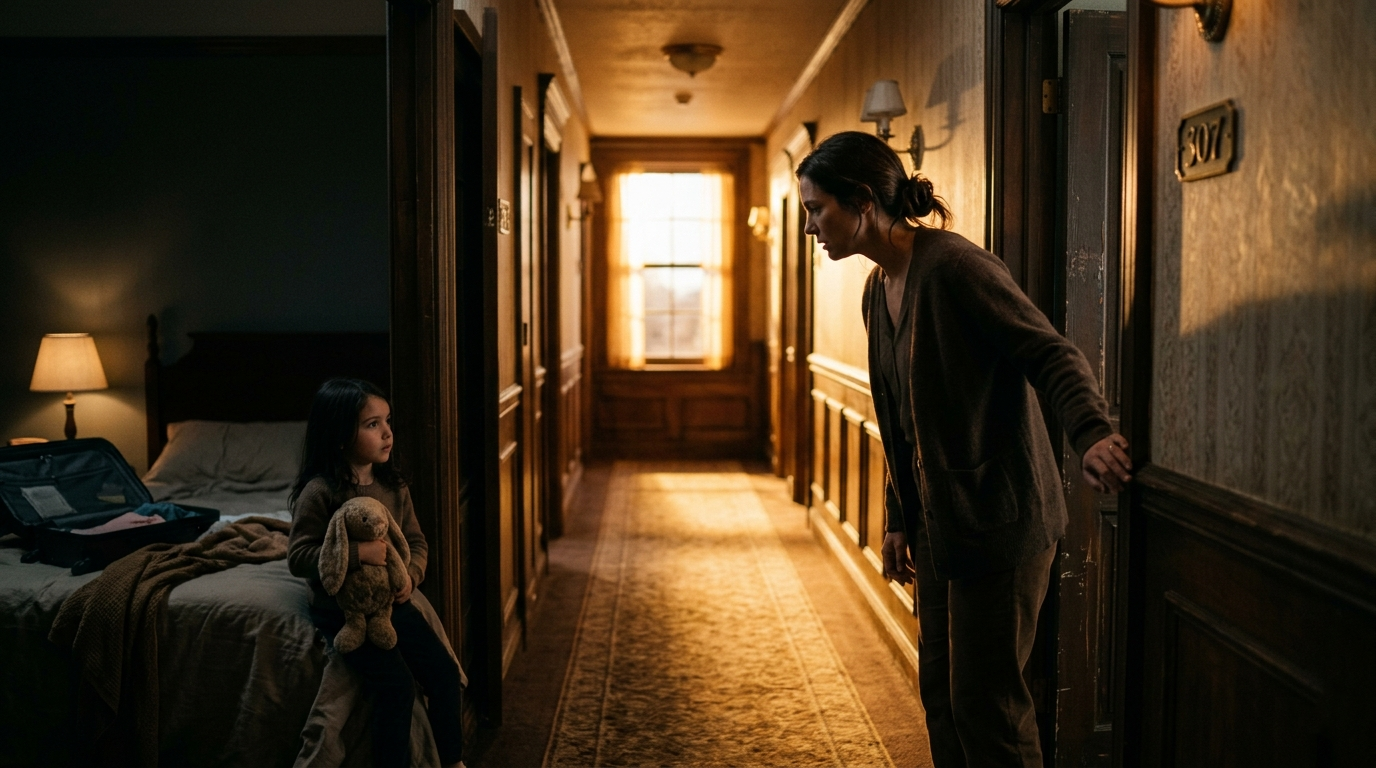
Room 114 was at the end of a first-floor hallway that smelled like hotel carpet and stale air conditioning. Marcus waited in the lobby. I knocked.
Daniel opened the door and looked at me and immediately looked like a man who had been holding himself together with the thinnest possible material and had just felt it give way. He looked like he had not slept in three days, because he hadn’t. He opened his mouth and I held up my hand, not unkindly, because I could not do his falling apart and mine at the same time and I needed to see her first.
“Where is she?” I said.
He stepped back. I walked in.
She was sitting on the far bed with her shoes on, like she had been told to be ready. She was small, dark-haired, wearing a purple shirt with a butterfly on it that I would later learn had been her mother’s favorite color too. She was holding a stuffed rabbit that was worn thin at the ears. And she was doing exactly what Daniel had described in the voicemail — holding perfectly, completely still, watching me with dark eyes that were his eyes, waiting to find out what kind of thing was about to happen.
I sat down on the end of the bed. Not too close.
“Hi, Lily,” I said. “My name is Mara.”
She looked at me for a long moment. Then she said, with the devastating directness of a seven-year-old: “Are you my dad’s wife?”
“I am,” I said.
She considered this. “He cried,” she said. “When he first saw me. He cried a lot.”
“Yeah,” I said. “He does that when things matter to him.”
She looked down at the rabbit. Then back up at me. “He said you were really nice,” she said. “He said you were the nicest person he ever met.”
I looked at Daniel, standing in the corner of the room, a hand pressed over his mouth.
I looked back at Lily.
I said: “I’m going to try to be.”
We did not go home that day. We went home the next morning, all three of us in Marcus’s car because no one was in a state to drive themselves, Lily in the back seat with her rabbit and a bag that contained almost everything she owned, asleep before we hit the highway.
Daniel and I talked — truly talked — for the first time at a diner outside of Chattanooga while Marcus sat with Lily in the booth across the room and kept her occupied with a stack of pancakes and his phone. We talked for two hours. I asked every question I needed to ask. He answered every one of them without flinching, without softening, without asking me to be more comfortable than I was. He told me about Rebekah, about the four months in Atlanta, about the call on Sunday night. He told me about the drive down — how he had pulled over twice because he couldn’t see through the crying, and how he had sat in the parking lot of the social services office for forty-five minutes before he could make himself go in.
He told me about seeing Lily for the first time.
“She looked up at me,” he said, “and she had my mother’s chin — exactly my mother’s chin — and I just — I couldn’t—” He stopped. Pressed his hands flat on the table. Started again. “I didn’t know what I was going to feel when I saw her. I thought maybe nothing. I thought maybe I’d feel like I was looking at a stranger. And then I looked at her and she was not a stranger at all, and I didn’t know what to do with that.”
I asked him the hardest question last.
“Did you think about not telling me?”
He was quiet for a moment. “For about forty-five seconds,” he said. “In the parking lot. I thought — what if I just handle this alone. What if I find some way to do this without blowing up everything we have. And then I thought — there is no version of that where I’m not lying to you for the rest of our lives. And I would rather blow up everything we have than lie to you for the rest of our lives.” He looked at me. “You have always deserved the truth. Even when the truth is this.”
I looked at my husband across that diner table. I thought about nine years of steadiness. I thought about the miscarriage we had grieved together, the evenings on our back porch, the small continuous acts of someone who had chosen me and kept choosing me. I thought about a seven-year-old girl asleep in a car outside, who had not chosen any of this and had already lost so much.
I reached across the table and I took his hand.
I did not have words yet. But I had that.
I will not pretend the months that followed were easy — they were not, and I won’t do you the disservice of skipping the hard parts.
There were weeks where I grieved the version of our life that had existed before the voicemail — the quieter version, the one where it was just us and the conversations we had been having about maybe trying again for a baby. There were nights where the anger finally arrived in full and I had to figure out what to do with it, because the truth was that Daniel had not wronged me intentionally and yet there was a wrongness in the situation that needed somewhere to land. I went to therapy. We went to therapy together. I recommend both.
There were hard days with Lily, too. She had lost her mother. She was seven years old and grieving and occasionally furious and occasionally heartbreakingly sweet and always, always watching — taking everything in with those careful dark eyes, measuring whether this new place was safe, whether these new people would hold.
There was one evening about two months in when she came into the kitchen while I was making dinner and stood beside me at the counter and said, without looking up: “At my old school, we made cards on Mother’s Day. For our moms.” A pause. “I don’t know what I’m supposed to do this year.”
I turned off the burner. I turned to face her.
“You don’t have to do anything you don’t want to do,” I said. “But if you want to make a card for your mom — the one who raised you and loved you — I will help you make the most beautiful card anyone has ever seen. And we can figure out somewhere special to leave it.”
She looked up at me. Something in her face shifted — not all the way, not yet, but the beginning of something.
“Okay,” she said. Very small.
We made the card at the kitchen table that Saturday. Daniel sat with us. Marcus came over and sat with us too because by then he had become a fixture and Lily had decided she approved of him, which was the highest available rating. We used watercolors and every color she chose herself and she worked on it with the focused, total concentration of a child who is putting something real into something small.
She chose a field of sunflowers. Her mother, she told us while she painted, had loved sunflowers.
I think about who I was the morning of that voicemail often. The woman on the kitchen floor with the cold coffee, in yesterday’s clothes, who had spent three days in the particular terror of not knowing.
I think about how certain I was, in those three days, that whatever the explanation was, it was going to be something I could not survive whole.
I was wrong about that. Not because what Daniel told me was small — it was not small, it has reshaped every part of our lives — but because surviving is less about the size of the thing and more about what you decide to do while you’re in the middle of it. I decided to drive to Atlanta. I decided to sit on the end of that bed. I decided to take his hand across a diner table.
Those decisions, each of them, were a choice to remain. Not to forgive blindly, not to smooth over the difficulty, but to stay present in the reality of it and see what could be built there.
Lily has been with us for eight months now. The adoption process is underway. She started second grade in September at the school three blocks from our house and has made two friends she talks about constantly and a teacher she adores. She still sleeps with the rabbit. She has stopped holding as still when she’s thinking — or maybe she still does it and it’s become so familiar that I’ve stopped noticing it the way you stop noticing the sounds of your own house.
Last week she drew a picture at school — one of those assignments where you draw your family. She brought it home in her backpack and spread it on the kitchen table for us to look at.
There was Daniel, tall and stick-armed. There was Marcus, slightly rounder because Lily is an accurate artist. There was me, in a blue dress I actually own, which made me laugh.
And there was Lily, in the middle of all of us, in purple.
She had drawn the sun very large and very yellow in the corner of the page, and she had written, in the careful, effortful print of a child who is still learning that letters go one direction:
MY FAMLY.
Daniel and I looked at each other over the top of that drawing.
He was crying, quiet and steady, the way he does when something matters too much for any other response.
I was too.
But this time, I understood the tears completely.
And they were exactly what they looked like.
— End of Story —