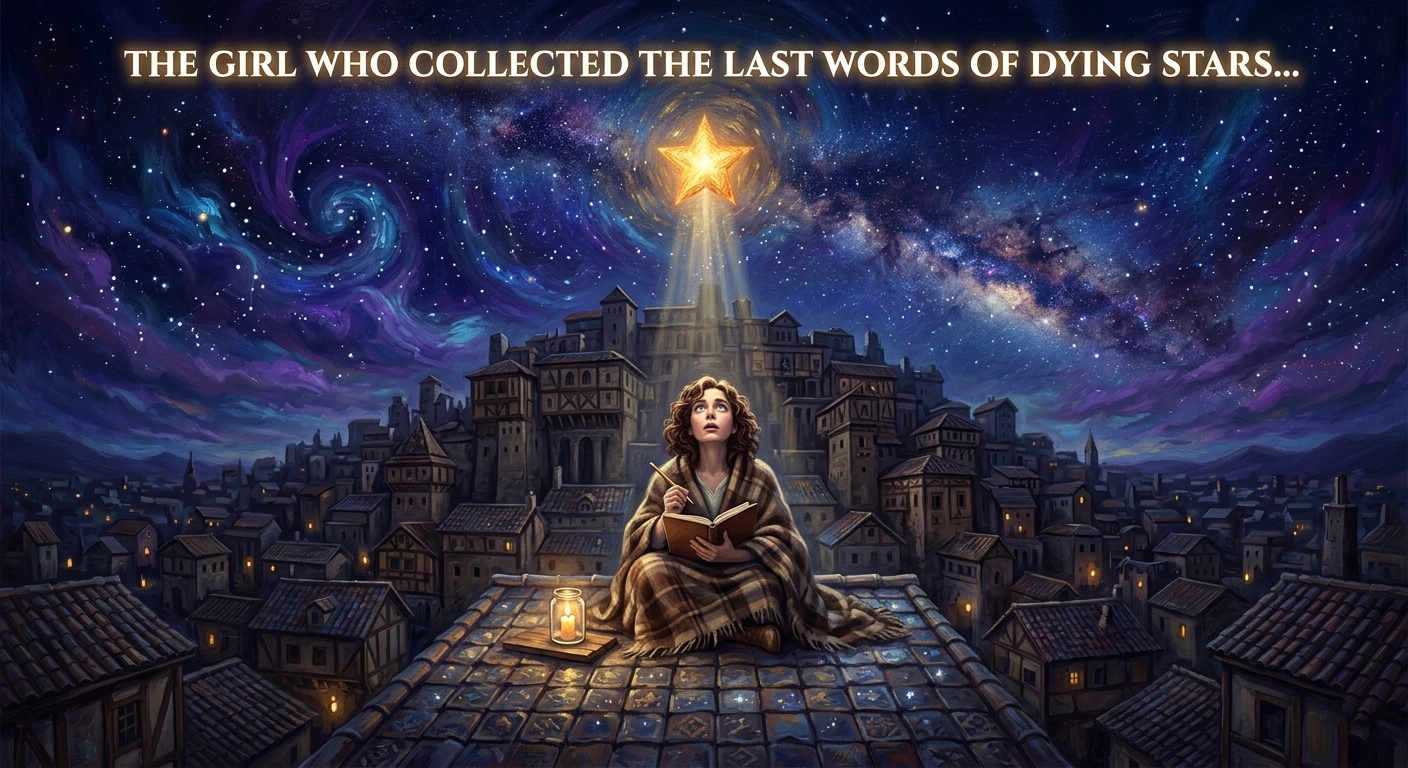
The Girl Who Collected the Last Words of Dying Stars — Until One of Them Had Something to Say to Her !
Once, in a city built on the highest hill in the known world, there was a girl named Lyra who could hear the stars dying.
Not all people could. Most people looked up and saw only light — steady, distant, beautiful in the uncomplicated way of things that ask nothing from you. They saw the night sky the way they saw the ocean from a cliff: magnificent, unknowable, essentially silent.
But Lyra had been born on the night of a great celestial event — a falling of stars so numerous and so bright that the midwife who delivered her had stopped her work for a full minute and simply stood at the window with her mouth open. Her mother, who was practical in the way of people who have had to be, said it meant nothing. Her father, who was a dreamer in the way of people who cannot help it, said it meant everything.
The truth, as it usually does, lived somewhere between them.
From the time she was very small, Lyra heard things in the night sky that others did not. Not voices, precisely — more like the feeling of a voice, the shape of meaning without the words, the way you know someone is speaking in the room next to you even through a wall. She heard it as a low and resonant vibration, somewhere below sound, that settled in her chest like a second heartbeat.
When she was seven she told her mother.
Her mother stroked her hair and said: that is the wind, love.
When she was nine she told her teacher.
Her teacher nodded carefully and wrote something in a notebook that Lyra was not allowed to see.
When she was eleven she told no one.
Instead she went to the market and spent every coin of her birthday money on a notebook — thick, leather-covered, with a clasp — and that night she climbed to the roof of her family’s house with a candle in a glass jar and she listened, and she wrote down what she heard.
It was imprecise, at first. She was translating something that had no direct equivalent in any human language — taking the felt sense of dying light and finding words that were close enough to hold it without breaking. She spent years at this. She developed her own system, her own notation, a private grammar of endings that no one else could fully read.
But she could read it.
And what she read, over years and years of rooftop nights, was this: every star, in the last moments of its light, had something to say. Not all of them said the same thing. Some spoke of distances so vast they had no human measure. Some spoke of the particular loneliness of burning for a billion years in the dark, beautiful and unreachable. Some spoke of the things that had formed in their warmth — planets, atmospheres, oceans, lives — and how they had watched it all from too far away to touch.
Some spoke of love. Not love as humans speak of it, small and urgent and personal, but love as a structural force — the thing that makes matter want to be near other matter, that holds systems together, that is, at the deepest level of everything, the reason anything coheres at all.
These last words were the ones Lyra wrote most carefully.
By the time she was twenty she had filled forty notebooks.
By the time she was thirty, two hundred.
She lived alone in a small house at the top of the hill, near the observatory that the city’s astronomers used — though they used it differently, with instruments and mathematics and the clean language of measurement, and they were polite to Lyra in the way that scientists are sometimes polite to poets, which is to say with a respect that contains, very quietly, a reservation.
She did not mind.
She had her notebooks and her rooftop and her candle in a glass jar, and the sky was full, and there was always another voice just at the edge of hearing.
She was good at her work. She was diligent. She was, by any measure, a collector of extraordinary things. And yet —
And yet.
There was something she had noticed, in the thousands of last words she had recorded, that she had never written in any notebook, because it was not the kind of thing that fit in notebooks. It was this: every dying star spoke of being witnessed. Of having its light received. Of the difference — the immeasurable, uncountable difference — between burning in the dark and burning in the dark while something somewhere turned its face upward and noticed.
She had witnessed ten thousand of them.
Not one had witnessed her.
This was not a complaint she allowed herself often. She was not, by nature, someone who asked to be seen. Asking to be seen had always felt to her like asking for something slightly embarrassing — as if need were a kind of weakness, as if self-sufficiency were the highest virtue and loneliness merely its shadow, to be managed and not mentioned.
She managed it.
She mentioned it to no one.
On the night of her thirty-third birthday, she climbed to the roof as she always did, with her candle and her notebook, and she wrapped herself in the old wool blanket she kept up there, and she looked up.
The sky was extraordinary that night. Clear and deep, the kind of night that makes the sky look not like a ceiling but like a depth — like you are not looking up but looking through, into something vast and layered and alive.
She found her place among the stars the way a musician finds the key — by listening until she felt the resonance locate itself in her chest.
And then she heard it.
Not a new voice. An old one. The oldest she had ever encountered — a low and massive vibration that she felt not just in her chest but in her teeth, in her bones, in the soles of her feet flat against the tiles of the roof. It was the sound of something that had been burning for so long it contained the memory of a time before any of the other stars existed.
She opened her notebook.
Her pencil was ready.
And then the voice — which was not a voice but the fullest possible version of the feeling of one — did something no star had ever done in thirty-three years of her listening.
It stopped speaking about itself.
It turned.
She felt it the way you feel someone’s gaze cross the room and find you, that specific and unmistakable sensation of being the object of attention rather than its source. Every hair on her arms stood. The candle flame went perfectly, impossibly still.
The star — the oldest star in the sky, the one that had been burning since before the world had a name — was looking at her.
And it spoke.
She wrote as fast as she could, her hand shaking, the pencil pressing so hard it nearly tore the page. She wrote for a long time. The voice went on and on, low and resonant and sure of itself in the way of things that have had a billion years to decide what they mean.
When it was finished, she sat in the silence for a very long time.
Then she read what she had written.
The star had said this:
You have been listening since you were seven years old. You have given your ear to ten thousand endings and asked for nothing in return. You have sat alone on this roof through cold and heat and grief and the years that passed without being held by anyone, and you have kept your face turned upward, and you have kept your notebook open, and you have believed — without being told, without any evidence, on pure and stubborn faith — that the things dying in the dark deserved to be heard.
We have all heard you.
Every star whose last words you wrote down — we heard you writing. We felt the weight of your attention. We burned a little longer, some of us, because you were there. We were less alone in our ending because you turned your face up. You think you have been collecting our words. You have also been holding our light. The two things are not different.
You asked — not in any notebook, not in any language, but in the way that the real questions are asked, without words, deep in the chest where no one can hear — you asked whether anyone had noticed you. Whether your vigil had a witness. Whether the one who tends the light is also, herself, seen.
We see you, Lyra.
We have always seen you.
You are not the collector. You are the reason the collection matters. The last words of dying stars are not made meaningful by being recorded. They are made meaningful by being received — by the fact that you climbed to this roof, night after night, alone, and opened yourself to the enormous dark and said: I am here, I am listening, nothing that tries to speak will speak into silence while I am alive.
That is not a small thing.
That is everything.
We want you to know — before we go, before the last of this light crosses the distance between us — that you are not only the witness. You are also the witnessed. You are also the light. You have been burning, quietly, steadily, faithfully, in the dark for thirty-three years, and we have been warmed by you, and we have been less alone in the burning, and we will carry you — the fact of you, the shape of your attention, the specific and unrepeatable quality of your care — we will carry you into whatever a star becomes when it finally goes out.
Which is not nothing.
Which is never nothing.
She sat on the roof until the sky began to pale.
She watched the oldest star fade — not suddenly, not dramatically, but in the slow and dignified way of things that have lasted long enough to leave on their own terms. It dimmed and dimmed, and then the dawn came up around it, and it was gone.
She closed her notebook.
She held it against her chest with both hands for a long time, the way you hold something you do not want to put down because putting it down would mean you have to decide what comes next.
Then she climbed down from the roof.
She made tea. She sat at her kitchen table. She looked at her hands — the right one still smudged with pencil, the left still faintly cold from the night air — and she thought about burning. About how she had spent her whole life convinced that light was something you gave and not something you were.
About how the oldest star in the sky had told her otherwise.
She opened a fresh notebook.
On the first page she wrote, in her careful private grammar, the last words of the oldest star. Every word, exactly as she had received them.
Then she turned to the second page.
And for the first time in thirty-three years of rooftop nights, she wrote something that was not a transcription. She wrote something of her own — in plain language, no notation, no system, just words in the order that they came.
She wrote about the roof. About the blanket and the candle and the cold. About her mother saying it was the wind and her father saying it meant everything. About the forty years she had given to the sky, and how she had never once thought to ask the sky to look back.
About what it felt like when it did.
She wrote for a long time. She wrote until the tea was cold and the morning was fully arrived and the city was beginning its noise below her window.
Then she stopped. She read what she had written. She sat with it.
She did something she had not done in years, perhaps ever — she opened her door, and she walked down the hill, into the city, and she found the first person she came to — a baker, arranging loaves in a window, who looked up when she stopped outside —
And she said: I have something to tell you.
The baker, who was a practical woman and had bread to sell and a morning to manage, looked at this small serious person standing on the pavement with pencil on her hand and stars in her eyes and a notebook pressed against her chest.
She said: Come in, then.
And Lyra went in.
And she told it.
All of it.
She told the baker, and the baker told her husband, and her husband told the men at the corner, and the story moved through the city the way light moves — not asking permission, not following roads, finding its way through every gap until the dark has nowhere left to stand.
And in that city, on that hill, on every clear night from that one forward, you could find people on their rooftops.
Not all of them heard anything.
But they looked up.
All of them looked up.
And the stars — which had been burning for longer than anything had been alive to see them — burned a little warmer.
Because that is what being witnessed does.
To stars. To people. To anything that has been doing the brave and quiet work of shining in the dark.
It makes the burning worth it.
It always has.
The end.