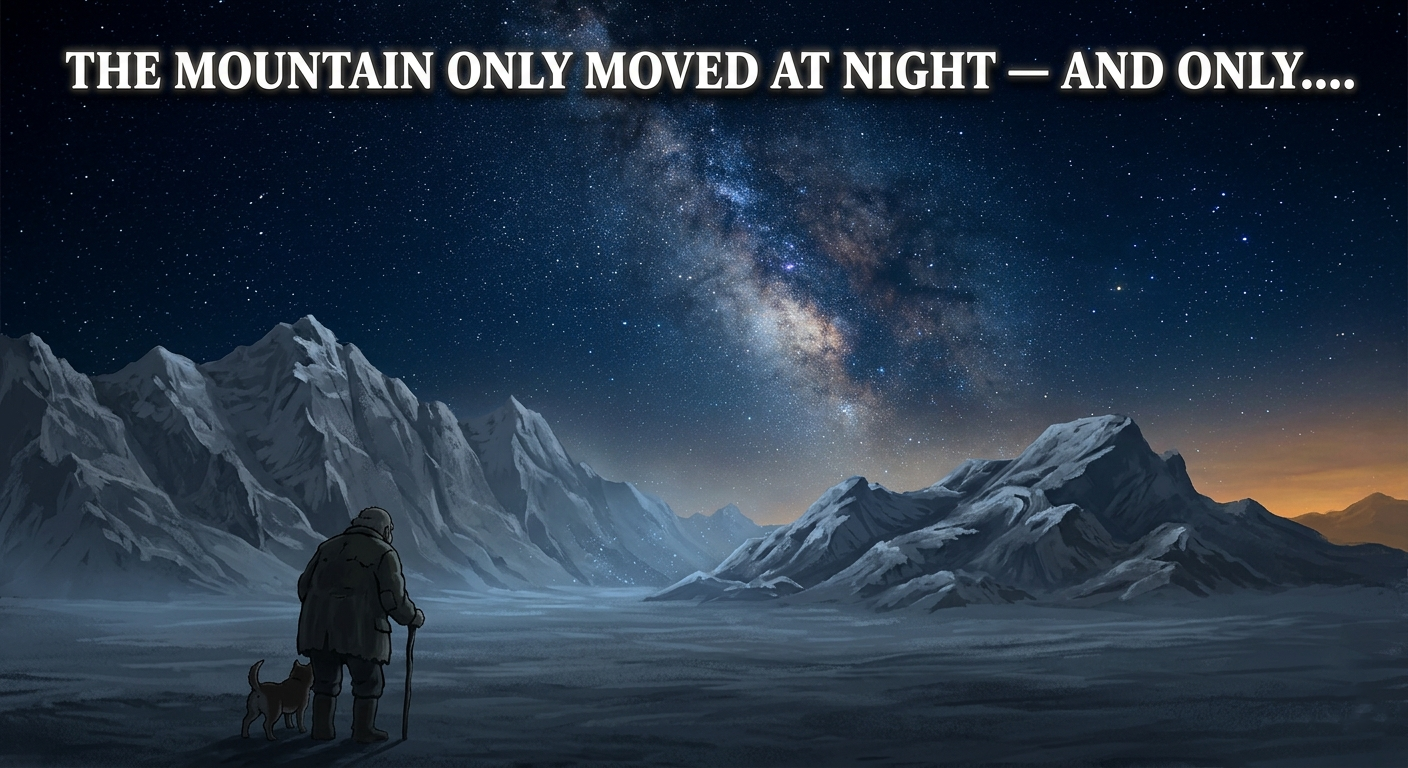
The Mountain Only Moved at Night — and Only the Old Shepherd Who Couldn’t Sleep Ever Saw Where It Went !
Once, in a valley so tucked into the folds of the world that it appeared on no map made by human hands, there lived an old shepherd named Emory.
He was seventy-one years old, or thereabouts — he had stopped keeping precise count around sixty-five, when precision began to feel less like a virtue and more like a kind of vanity. He had lived his whole life in the valley, as had his father, as had his father’s father, as had every generation of his family stretching back to a time when the valley itself was younger and the mountains around it still deciding their final shapes.
He knew the valley the way you can only know a place you have never left — not just its roads and its fields and its seasons, but its moods. The particular quality of its silence before rain. The way the light moved across the eastern slope in the hour before sunset, slow and amber and deliberate, like a hand smoothing a cloth. The sound the wind made coming through the high pass in winter, which was different from the sound it made in summer, which was different again from the sound in autumn, which Emory thought was the loneliest and most beautiful sound in the world.
He had a flock of thirty sheep, a dog named Fig, and a stone cottage at the foot of the valley’s northern slope that he had built himself forty years ago with stones pulled from the same ground he now walked every day.
He had a wife once. Her name was Maren. She had been gone eleven years, and he thought of her the way he thought of the mountains — as something so permanently part of the landscape of himself that her absence was not an emptiness but a shape, defined and familiar, that he had learned to live around.
He could not sleep.
He had not slept well since Maren died, which the village doctor attributed to grief and age and the particular restlessness of a man who had worked hard all his life suddenly finding the nights too long and too quiet. Emory did not argue. He simply accepted it, the way he accepted the weather, and filled the hours before dawn with small tasks — mending, reading, sitting at his window with a cup of tea, watching the dark.
It was watching the dark that showed him.
The mountain the valley people called the Grey Shoulder had stood at the northern edge of the valley for as long as anyone could remember — a broad, heavy, granite presence, its upper slopes bare and pale, its lower flanks dark with pine. It was not the tallest mountain in the range, but it was the most present, somehow — the one that dominated the view from the village square, that caught the first light every morning and held the last light every evening, that anchored the valley’s sense of itself.
It had always been there.
Except.
Emory noticed it first on a night in early autumn, unable to sleep, sitting at his window with his tea going cold. He was looking at the mountain — not examining it, just resting his eyes on it the way you rest your eyes on something familiar — when something shifted.
Not dramatically. Not a rumble, not a tremor, not the theatrical collapse of a landslide. More like — the way a sleeping person shifts in a bed. A settling. A repositioning. A change so subtle that if you had not been watching the exact right spot at the exact right moment you would have missed it entirely.
He set down his cup.
He watched.
Nothing more happened. The mountain sat where it had always sat, grey and enormous and still. The night was silent. Fig was asleep by the hearth.
Emory told himself it was his eyes. He was old. He had not slept. He went to bed.
But the next morning, making his slow way up the northern slope to check on the flock, he paused at the stone wall he had built thirty years ago to mark the field’s edge — a wall he could have found blindfolded, had walked past ten thousand times — and he stopped.
The wall was in shadow.
It was not in shadow at this hour. Not at this time of year. The morning light hit this wall directly from the east, had done so for thirty years without exception.
But the Grey Shoulder was not quite where it had been the day before.
Not far. A degree, perhaps. Perhaps two. Enough to shift its shadow by a few feet, no more. Enough that no one who was not already watching would notice. Enough that Emory stood at his stone wall in the morning light and felt the particular cold sensation of something you cannot explain landing solidly in your chest.
He watched the mountain the next night, and the night after that.
He watched it for two weeks.
It moved every night. Always after midnight, always before dawn, always in that same quiet way — a repositioning, a settling, unhurried, purposeful, as if the mountain were not moving at random but going somewhere specific and knew the way.
He told the village.
He told them on market day, standing in the square with his hat in his hands, which was the posture he adopted for serious things, and he said it plainly: the Grey Shoulder moves at night. He had seen it many times. He had measured the shadow of his stone wall. He was certain.
The village listened with the particular attention that people give to things they have already decided are not true. There were nods. There were kind expressions. A woman named Dora, who had been the village doctor since Emory was forty, put her hand on his arm and said she thought he might benefit from a tonic for sleep.
The miller’s son, who was twenty and had the confidence of someone who had not yet been wrong about anything important, said that mountains did not move. That was, in fact, the primary quality of mountains. Had been since always.
Emory thanked them and went home.
He was not angry. He was not wounded. He had spent seventy-one years in this valley and had learned, as the long-lived tend to learn, that the difference between a thing being true and a thing being believed was sometimes very large, and almost never the point.
He kept watching.
On a night in late October — cold, cloudless, the stars so bright and close they seemed to have come down a floor — Emory made a decision.
He put on his heaviest coat. He laced his boots with the extra care of someone who expects to walk a long way in the dark. He filled a flask with hot tea and tucked it inside his coat, next to his chest where it would stay warm. He found his old walking stick — ash wood, worn smooth at the grip — and he woke Fig with a gentle hand on the dog’s flank.
He went out the door.
He stood at the edge of his property and looked at the Grey Shoulder, dark and massive against the starry sky, and he waited.
Midnight came, as it always does, without announcement.
The mountain moved.
Not the subtle shift he had watched from his window — up close, at the foot of the slope, it was something else entirely. The ground beneath his boots hummed, low and deep, like a note played on an instrument so large he was inside it. The pine trees on the lower slope swayed without any wind. And the mountain — the whole enormous weight of it — began to move.
Slowly. So slowly that if he looked directly at it he could not be certain. But at the edges of his vision, the way stars are sometimes brighter when you don’t look straight at them, he could see the skyline shifting. The silhouette changing. The Grey Shoulder turning — turning — and beginning to move up the valley toward the high pass in the north.
Emory walked after it.
Fig stayed close at his heel, which was unusual for the dog — who was, in ordinary circumstances, an explorer — and Emory took it as confirmation that this was not an ordinary night.
He followed the mountain for an hour, maybe two — he lost track in the way of dreamers and the very old, for whom time moves by feeling rather than measure — up through the valley floor, past the sleeping farms, past the dried riverbed, past the last fence post, into the wild northern country where the valley opened into a high flat plain that Emory had not visited in years.
The mountain stopped.
He stopped.
Before him, in the cold starlight of the high plain, the Grey Shoulder settled with the same quiet deliberateness with which it moved — not collapsing, not landing, just arriving, the way something returns to a place it has been before.
And then Emory saw what the mountain had been going to.
In the center of the high plain, half-buried by decades of accumulated earth and snow-melt and the slow patient work of time, was another mountain.
Or the ruin of one. The suggestion of one — an old upheaval of stone that had been, long ago, something enormous, and had since collapsed into itself, lying spread across the plain like something that had been sleeping for centuries.
The Grey Shoulder moved to the edge of the fallen stone and was still.
Emory stood at a distance and watched.
And then, in the deep silence of the high plain, in the cold and the dark and the impossible starlight, he heard something.
Not a voice. Not a sound he could have described to the miller’s son or to Doctor Dora in any language they would have accepted. More like a quality of the air changing — a resonance between the two mountains, the standing and the fallen, low and vast and old beyond any measure Emory possessed.
He understood it, though. The way you understand something that bypasses language entirely and speaks directly to the older, deeper part of you — the part that is made of the same materials as mountains, the same compressed time, the same fundamental substance.
The Grey Shoulder was keeping the fallen one company.
That was all.
That was everything.
Every night, for longer than the valley had been inhabited, for longer than any human story could reach — the mountain had been coming here. To this plain. To this fallen companion. To sit with the thing that had collapsed and could not go to it.
Not to fix it. You cannot fix a fallen mountain. Not to restore it. Not to make it into something it no longer was.
Just to be beside it.
Just to say — with the whole of its enormous, granite, ancient self — I am here. I have not forgotten you. You were a mountain and I knew you when, and I know you still, and I will come back tomorrow night, and the night after, and every night that I am standing I will come to the place where you fell, and you will not be alone in it.
Emory sat down on the cold ground.
Fig climbed into his lap, which the dog had not done since puppyhood, and pressed his warm weight against Emory’s chest.
Emory put his arms around the dog and looked at the two mountains — the standing and the fallen, the present and the lost — and he understood, with the full and quiet force of something that has been working its way toward you for eleven years, that he had not come here only to follow a mountain.
He had come here because of Maren.
Because he was the Grey Shoulder. Because she was the fallen stone in the high plain. Because he had been moving toward her every night in every way available to him — in his sleeplessness, in his watching, in the long hours at the window with cold tea and the valley dark around him — without knowing what he was doing or why, only that some part of him refused to stop.
You cannot fix a fallen mountain.
But you can come back.
Every night, you can come back.
He cried, there on the cold ground of the high plain, with the dog in his arms and the stars enormous overhead and the two mountains keeping their ancient, faithful vigil beside him. He cried the way the very old sometimes cry — not with the sharp immediacy of fresh grief but with the deep, slow release of something that has been pressing for a long time against a door, and has finally been let through.
He stayed until the first pale line appeared at the horizon.
Then he stood, his old knees complaining, and he looked at the Grey Shoulder one last time.
The mountain began to move.
Back down the valley. Back to its place at the northern edge, its familiar silhouette, its thirty-year shadow falling on his stone wall at the correct angle for the time of day.
Emory walked home beside it.
When he arrived at his cottage, he sat at his table and he wrote down what he had seen. Not because he expected to be believed. Not for the miller’s son or for Doctor Dora. But because some things deserve to be written, to exist on a page in someone’s careful hand, to be given that small, particular permanence.
He wrote for a long time.
Then he made tea. He sat at his window. The sun came up over the Grey Shoulder exactly as it always had — amber and slow and deliberate — and the shadow fell across his stone wall exactly as it should.
Everything was as it had always been.
And completely different.
He slept that morning. Deeply, fully, without dreaming. The first real sleep he had managed in eleven years.
When he woke in the afternoon, Fig was at his feet and the valley was golden with the low light of an October sun, and Emory lay in his bed for a moment listening to the quiet.
It was still quiet.
But it was a different quiet than before. Not the quiet of absence — of a space where someone used to be. More like the quiet of a thing fully understood. The quiet of a man who has walked far enough in the dark to finally arrive somewhere.
He got up.
He made soup.
He went out to check on the flock, and the sheep were where they should be, and Fig ran ahead the way Fig always did, and the mountain stood at the northern edge of the valley, solid and enormous and grey, looking — as it always looked — as if it had not moved an inch.
Emory smiled at it.
He did not tell the village again what he had seen. He had told them once. That was enough.
But on winter evenings, when the young people gathered at the tavern and the talk turned to the old shepherd who believed the mountain walked at night, someone would sometimes ask him — not unkindly — if he still thought it was true.
And he would set down his cup and look at the window, at the dark where the mountain’s silhouette was just visible against the stars, and he would say:
Go without sleep sometime. Sit at your window in the deep of night. Watch what you always thought was permanent and still and ask yourself whether you are sure.
Then ask yourself — whatever it is you have lost, whatever has fallen that you cannot fix — whether you have been going back to it. Every night. In every way available to you.
Because I think most of us are.
I think that is what we do, when we love something.
We keep going back.
Even mountains.
The end.