The Boy Who Was Born Without a Shadow Spent His Life Looking for It — and Found Something Better !
Once, in a village of perfectly ordinary people who cast perfectly ordinary shadows, a boy was born who cast none at all.
His name was Cael.
The midwife noticed first, holding him up in the lamplight of the delivery room, and seeing — where there should have been a small dark shape on the wall behind him — nothing. Just wall. Just light, passing through the space he occupied as if he were made of something other than the usual materials.
She said nothing. She was a practical woman who had delivered four hundred and twelve children and knew that some things were better observed than announced.
But these things have a way of announcing themselves.
By the time Cael was three, everyone in the village knew. Not because his parents had said anything — they were quiet, private people who loved their son with the uncomplicated totality of parents who have decided that the world’s opinion of their child is not a thing they are responsible for managing. But because children see everything, and children talk, and by his third birthday there was not a family in the village who had not discussed, in some configuration, the boy who had no shadow.
The opinions were many and various.
Some said it was a blessing — that he had been marked by light, chosen, set apart for something the rest of them could not see yet. These people tended to watch him with a warmth that was kind but slightly uncomfortable, the way people watch someone they have decided is significant before the significance has had a chance to reveal itself.
Some said it was an ill sign — that the shadowless were people the darkness had already claimed, had taken the shadow as a down payment on something larger. These people kept their children a careful distance from Cael, which he noticed, because children always notice, and which settled into him as a low persistent ache he learned to carry the way you carry a stone in a shoe — present, manageable, not the kind of thing you stop every moment to address.
Most people said nothing definitive and simply found themselves slightly unsettled in his presence, without being able to say exactly why, which is often the most honest response to something genuinely unusual.
Cael grew up navigating all of this with the particular grace of a child who has had to develop grace early. He was thoughtful. He was gentle. He had a quality of attention — a way of listening that made people feel fully received — that his mother said came from spending so much of his childhood being looked at, which had taught him the relief and value of being truly looked to.
But he felt it. The absence. Not always, not every moment — but in the specific way that you feel a missing tooth with your tongue, returning to it involuntarily, pressing the gap to confirm it is still there.
He watched shadows the way other children watched birds or clouds or the river. He watched them move and stretch and pool and thin. He watched the way they followed their owners faithfully, attached at the heel, dark doubles that went everywhere their counterparts went, that grew long at evening and short at noon and disappeared entirely only when the light came from all directions at once.
He wanted one.
Not extravagantly. Not with the dramatic hunger of stories where the wanting becomes a consuming fire. Just quietly, consistently, the way you want a thing you have convinced yourself is normal to want and have not yet examined deeply enough to question.
When he was fifteen, he left the village.
His parents stood at the road’s edge on the morning he left, his mother holding her coat closed at the throat against the autumn chill, his father with his hand raised in the particular way of fathers who have said everything they know how to say and are now simply present. Cael hugged them both for a long time. Then he picked up his bag and turned toward the road.
He did not look back. Not because he did not love them — he loved them entirely — but because he knew if he looked back he would not go, and he needed to go, because the answer to the question of himself was not in the village where everyone already knew the question and had long since stopped expecting an answer.
He went looking for his shadow.
He was not entirely sure what looking for it meant. He had no map, no instruction, no prophetic dream pointing him in a particular direction. He simply went toward places where, according to every story he had ever heard, extraordinary things were found: the deep forests, the high mountains, the old cities built on the ruins of older ones, the shores of seas that had different names in different languages and were, some people said, the same sea dreamed differently by different coastlines.
He went to the forest of Ashenmere, where the trees were so old and so close that no light reached the ground and everyone who entered moved in a permanent shadow. He stood in the center of it, in the deep and absolute dark, and waited to feel something attach itself to him. Nothing did. The dark was simply dark, indifferent, equal for everyone.
He went to the mountain called the White Tooth, whose peak caught so much sun that climbers came back temporarily blind, and stood at the summit in the full blaze of it and looked at the ground around his feet. Nothing. The light fell on the stone and moved past him as it always had, as if he were a window and not a wall.
He went to the city of Thessavar, which was built entirely underground and had no natural light at all — where the people lived by lamplight and candlelight and the luminescence of certain mosses cultivated over centuries on the cavern walls. He thought perhaps the absence of light was the answer — that if there was no light there could be no shadow and he would be, for once, exactly like everyone else. But the people of Thessavar cast shadows from the lamplight. Long, wavering, amber shadows that danced on the cavern walls. Cael’s walls were bare.
He went to a woman in the eastern hills who was said to be very old and to know things that other people’s knowing had not yet reached. She looked at him for a long time when he arrived — looked at the space around him, and beneath him, and behind him — and then she looked at his face.
She said: What do you think your shadow is for?
He said: Everyone has one. It is simply what a person has.
She said: That is what a shadow is. I asked what it is for.
He did not have an answer.
She gave him tea and sent him away, not unkindly, with the suggestion that he sit with the question.
He sat with it for three years.
He kept traveling, because moving had become the way he thought, the way some people think by writing or by talking or by standing at windows. He moved through countries and seasons and languages, accumulating the kind of knowledge that can only be gathered by being in many places and paying close attention, and he noticed — slowly, without meaning to, without making a project of it — that he was beginning to understand people in a particular way.
Not their surfaces. Not what they presented or performed or protected. Something deeper and less deliberate — the shape of what they carried, the specific gravity of their particular sorrow or longing or unresolved love, the place inside each person where something had been pressed against for too long and needed, more than anything, to be seen.
He could not have explained how he knew these things. He simply did, the way you know a song you have never been taught — recognizing it as familiar before you have any reason for familiarity.
He began to stop.
He had always been moving toward something — toward the shadow, toward the answer, toward the place where the missing thing would finally be found. But he began to stop. To sit with people. To ask the question the old woman had asked him — not in those words, but in the wordless way that the real questions are asked — and to listen to what came.
A man in a fishing village who had not spoken to his brother in twenty years and did not know anymore what the original argument had been about, only that the silence had lasted so long it had become a kind of architecture — a structure he lived in without remembering he had built it. Cael sat with him for two days. He did not give advice. He did not suggest solutions. He simply listened, and asked the occasional careful question, and the man talked and talked until something that had been sealed for twenty years came open, and he wept, and the next morning he wrote a letter to his brother.
A young woman in a mountain town who was about to marry someone she did not love because she could not find the words to tell her family that she had always known, had always known, that her life was meant to go a different way — and she was terrified, terrified in the bone-deep way of someone whose love for the people they might disappoint is genuine and enormous. Cael sat with her one evening. He did not tell her what to do. He only said: What would you do if you were not afraid? And she said the answer out loud for the first time, and hearing it out loud made it real in a way it had not been inside her head, and she sat with the realness of it, and three days later she had the conversation with her family that she had been not having for years.
An old teacher who believed, after forty years of teaching, that he had made no difference — that the students had passed through him like water through a sieve, taking nothing, leaving nothing, and that his life’s work had been a kind of pleasant and prolonged futility. Cael spent an afternoon with him. He asked him to describe one student — just one, whoever came to mind first. The teacher described a girl who had struggled with numbers and who he had stayed after school to help, three days a week, for a full year, until something opened for her. One girl, thirty years ago. Cael asked what had happened to her. The teacher did not know. He found out, afterward — and found that she had become an engineer, and had named her daughter after the teacher, and had told the story of those three afternoons a week to everyone who asked her how she had found her way to numbers.
The teacher wept.
Cael moved on.
He was forty years old when he came back to his village.
He had not planned to come back. He had not planned anything for a long time — having discovered that the most important things rarely happen in the direction you are deliberately moving but tend to arrive sideways, from the corners of a life you were busy living for other reasons.
But he was forty and it was autumn and the road he was on had, without his quite deciding it, brought him to the valley he had grown up in, and to the road’s edge where his parents had stood the morning he left, and to the door of the house where his mother opened it before he could knock because she had, she said, been expecting him for a week without knowing why.
He stayed.
Not permanently — he was, by now, a person built for moving, and the moving was not restlessness but vocation. But for that autumn and winter he stayed, and he walked the village, and he sat with people, and he listened in the way he had spent forty years developing without knowing that was what he was doing.
And the village noticed.
Not the absence of his shadow — they had long since made their separate peaces with that, filed it under the category of Cael’s particular nature, moved on. What they noticed now was something else. A quality in the air around him. The way conversations with him left people feeling not just heard but somehow more themselves — clearer, lighter, as if something they had been carrying had been examined and found to weigh less than they had thought.
The miller’s daughter said it first, out loud, in the way that things become true when someone finally says them:
When you’re near him, you don’t feel shadowed.
She meant it simply — the specific way that anxiety and grief and old resentment cast their darkness over a person’s days, their shadow falling on everything including the good things, making the good things harder to see. She meant that near Cael, for some reason she could not fully articulate, that shadow lifted.
Cael heard this.
He sat with it the way he had sat with the old woman’s question, a long time ago in the eastern hills — with patience, without rushing it, letting it find its own depth.
And slowly, sitting with it, he understood.
He had spent forty years looking for his shadow because he had believed its absence was a lack. A thing missing. A deficiency in the basic materials of himself that needed to be found and corrected before he could be complete.
But a shadow is what happens when something stands between a person and the light.
He had never cast one.
He had never stood between anyone and the light.
He had spent his whole life — not by design, not by discipline, but by nature, by the simple fact of what he was — moving toward people in the dark and not adding to the dark but bringing with him whatever light he carried, and leaving people, when he left, with a little more of it than they had before.
That was not an absence.
That was the whole of the thing.
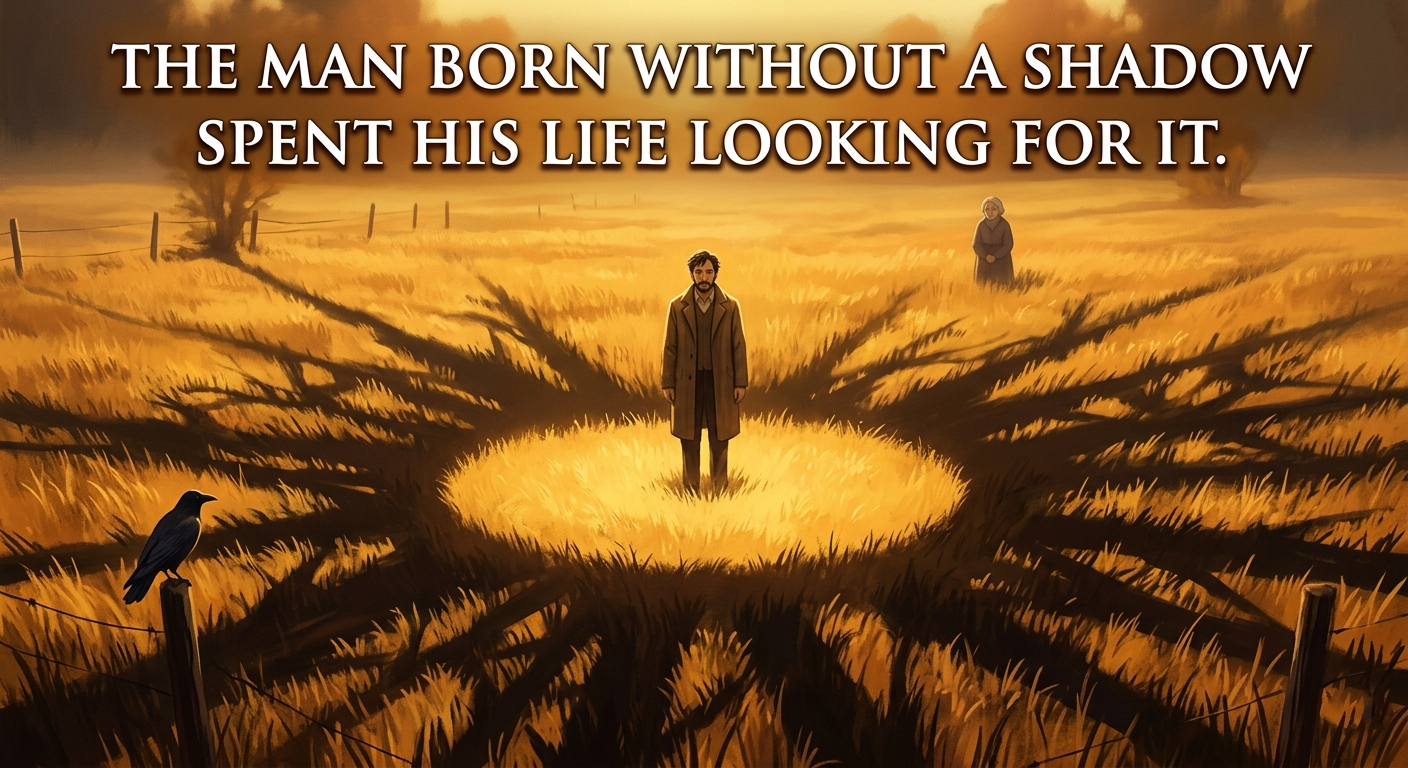
He walked to the field at the edge of the village where he had spent his childhood watching shadows stretch in the evening light. He stood in the center of it. The low autumn sun was behind him, golden, full. He looked at the ground before him — at the long shadows thrown by the fence posts, the trees, the farmhouse at the field’s edge — at everything that stood between the light and the ground and made its dark mark.
The ground before him was bright.
Unbroken light, right to his feet. Not because he was absent from the world — he was there, entirely there, fully and irreversibly present — but because nothing in him blocked what was passing through.
He stood in his circle of unbroken light and he laughed.
Not the laugh of someone who has been foolish and now sees it — there was no foolishness in forty years of sincere searching. But the laugh of someone who has arrived somewhere so much better than the destination they set out for that the only possible response is the full and helpless joy of it.
His mother was at the field’s edge. She had followed him, the way mothers follow their children sometimes without explaining why.
She looked at the circle of light around his feet.
She had looked at that circle every day of his childhood and called it his name — called it Cael, not absence, not deficiency, not the thing that was missing — and she had been right, the way mothers are sometimes right about their children before the children are right about themselves.
She said nothing.
She walked to him.
She stood beside him in the field.
And her shadow stretched long and dark before her in the evening light, and beside it — beside it, in the space where his should have been — the ground was bright and warm and lit straight through.
They stood there together, the two of them, shadow and light, for a long time.
The sun went down.
The field went dark.
And for the first time in forty years, standing in the full dark with his mother beside him, Cael cast a shadow.
Small. Faint. The thinnest possible suggestion of a dark shape on the ground — barely more than a slightly deeper dark within the dark around it.
But there.
He looked at it for a long time.
Then he looked up at his mother.
She was smiling in the way of someone who has known the ending of the story for a very long time and has simply been waiting, with the vast and steady patience of love, for the person it belongs to to arrive there.
There it is, she said.
There it is, he said.
He understood then — fully, finally, with the completeness of a thing that takes a whole life to learn and arrives, when it arrives, with the simplicity of something that was always obvious — that you do not find yourself in the searching.
You find yourself in the giving.
You find yourself in the forty years of sitting beside people in their dark, in the listening, in the question asked carefully at the right moment, in the brother’s letter and the young woman’s conversation and the old teacher’s weeping.
You find yourself in what you leave in the light behind you.
And when you have left enough of it — when you have given enough of what you have, fully and without holding back, because you believed it was needed and you had it to give — the world, which has been watching all along, gives you back the thing you thought you lost.
Not as a reward.
As a recognition.
You were never missing anything, the world says.
You were always this.
The end.