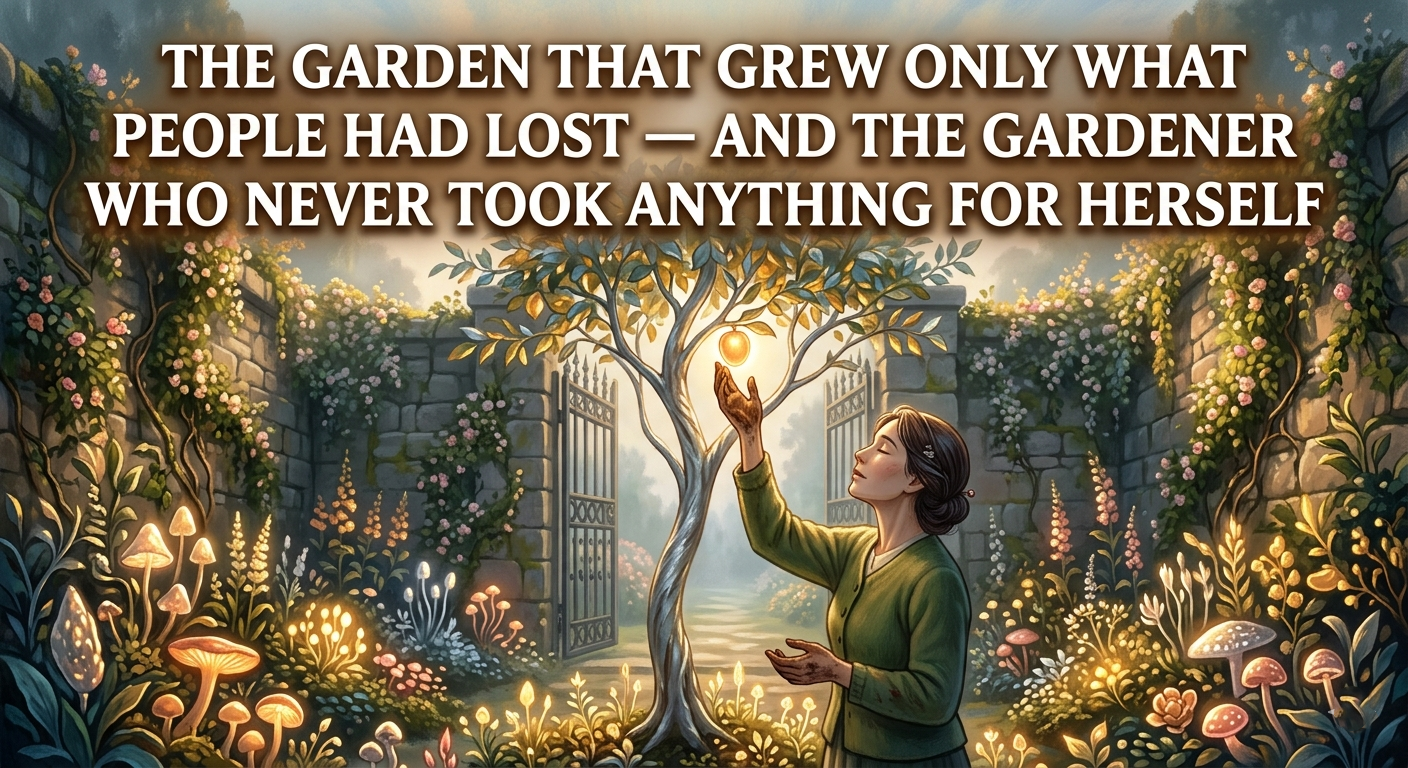
The Garden That Grew Only What People Had Lost — and the Gardener Who Never Took Anything for Herself !
Once, at the end of a road that appeared on no map and revealed itself only to people who were ready to find it, there was a garden behind an iron gate. The gate was not locked. It had never been locked. But it was heavy — heavier than iron alone could account for — and most people who reached it found that it required both hands and something more than strength to open. A willingness, perhaps. An admission. The particular humility of arriving somewhere with empty hands and saying: I have lost something.
I do not know if it can be found. But I am here. The garden behind the gate was not large, by the measure of gardens. But it was deep — deeper than its borders suggested, deeper than the land it occupied should have permitted, as if it extended downward into the earth in ways that had nothing to do with ordinary soil. It grew in rows and clusters and wild tangled patches that seemed to have arranged themselves according to a logic that was not immediately apparent but revealed itself, slowly, to anyone who walked through it carefully enough. The plants were not plants in any botanical sense that could be catalogued or classified. They were — presences. Living, rooted, reaching presences, each one with a quality of light around it that was its own and no other’s, a specific warmth or ache or radiance that you felt in your chest before you understood it with your mind.
This was the garden of lost things.
Not lost objects — though occasionally something small and material appeared among the roots, a ring or a letter or a child’s shoe, left there by whatever deep current moved lost things toward their proper resting place. What the garden mostly grew was the other kind of lost. The kind with no physical form and no clear moment of losing. The kind you only notice is gone when you reach for it one day and find the place where it used to be.
Lost confidence — small pale blooms that trembled in any wind, that needed the most patient and consistent tending, that died back in cold weather and returned in spring smaller than before unless someone had kept them carefully through the dark months.
Lost time — not time itself, which cannot be recovered, but the feeling of time. The sense of spaciousness, of hours that belonged to you, of mornings without urgency. It grew as a low spreading plant with silver leaves that caught the light and held it longer than seemed natural, so that standing near it you felt, briefly, unhurried.
Lost words — the things people had meant to say and hadn’t. These grew as climbing vines along the eastern wall, dense and tangled, some of them ancient, some of them recent, all of them leaning always toward the light as if still trying to reach the person they had been meant for.
Lost versions of the self — the people you had been before something changed you, before the loss or the fear or the long slow weight of years reshaped you into someone more defended, more cautious, more careful with yourself than you used to be. These were the rarest and the most extraordinary plants in the garden — tall, many-branched, with flowers that looked different depending on who was looking, because what they showed was always specific, always personal, always the exact face of the self that the person standing before them had loved and mourned and mostly stopped believing could come back. The gardener’s name was Sylvie.
She was not old, exactly — but she was the kind of person who seems to have arrived at a settled, timeless quality that makes age beside the point. She had dark hair pinned back with practical pins, hands that were always soil-dark at the knuckles, and a face that was — not beautiful in the conventional sense, but deeply kind in a way that was more useful and more lasting than beauty.
She had been the gardener for as long as anyone could remember, and no one — not the people who came to the garden, not the scholars who had written carefully about it from a careful distance, not even Sylvie herself, if she were being honest — could say exactly how she had come to be there or what had brought her to the gate that first time or how she had understood, upon entering, that this was the work she was meant to do.
She simply knew. The way certain people simply know the thing they are for, without explanation and without needing one. Her work was this: she tended. She watered and pruned and staked and mulched and watched. She learned the specific needs of each variety of lost thing — which needed shade and which needed sun, which needed to be talked to and which needed silence, which needed to be left entirely alone for long stretches and checked on only from a distance, which needed their roots disturbed to grow, which would die if touched too early.
She learned all of it. She gave all of it. And when people came — as they came, one by one, through the heavy gate, with their specific losses and their uncertainty about whether they were in the right place — she met them where they were. She never asked what they had lost. She did not need to. She could feel it the way the garden could feel it — a kind of resonance, a specific frequency that each loss carried, that she had learned over years to recognize and meet with the right thing at the right time.
She walked with them. She showed them to the part of the garden that held what they were missing. She stood beside them while they looked, while whatever needed to happen happened — the recognition, the remembering, sometimes the weeping, sometimes just the long slow exhale of someone who has been holding their breath for years and has finally, here, been permitted to breathe.
And then she helped them take what was theirs.Not all of it came back. Some losses were too old, too fundamental, too deeply worked into the person’s structure to be fully undone. The garden did not promise restoration. It promised return — not of the thing itself, always, but of the knowledge that it had existed. That you had been, once, the person who had it. That the having of it had been real.Sometimes that was enough. It was usually enough.
People left the garden changed in the way that a room is changed when you open the windows — not different in its structure, but different in its air. Lighter. More itself. Sylvie watched them go and felt, each time, the satisfaction of work done rightly. The clean, complete satisfaction of a thing given fully and received. She never took anything for herself. This was not a rule anyone had given her. There was no charter of the garden, no instruction, no authority that had appointed her and set her conditions. It was simply how she had always done it, from the first day — she was the gardener, not the visitor. The tending was hers.
The harvest was theirs. That was the natural order of it, and she had never questioned it, had in fact never thought of it as a sacrifice or a withholding but simply as the correct arrangement, the way a river does not drink itself. She had lost things, of course. She was not exempt from loss by virtue of proximity to a garden that grew it. She had lost — over the years, in the way that years take things — her mother, early. A love, in her thirties, to a misunderstanding that hardened before either of them could find the words to soften it. The particular lightness she had carried in youth, that sense of uncomplicated possibility, before the weight of the work and the years had settled into her in ways she did not always feel but suspected were there.
She had lost, somewhere, the habit of wanting things for herself. Not as a dramatic renunciation. Not as a choice she remembered making. More as a slow drift, the way rivers change course — imperceptibly, over time, until one day the water is somewhere entirely different from where it began and the original channel is just a dry line in the earth, still visible if you know to look. She did not go to the parts of the garden that held her losses. She tended them the way she tended everything else — carefully, consistently, with full attention and no attachment — and she did not look at them as hers. She had learned not to look.
On a morning in middle spring — the kind of morning that arrives full of itself, warm and unambiguous, certain of its own beauty in the way of things that do not need to be told — Sylvie was in the garden before sunrise, as she always was, doing the first slow walk of the day. The first slow walk was her favorite part. Before the gate opened and the visitors began to arrive, before the work of meeting and tending and walking people to their specific losses. Before anything was required of her. Just the garden in the early light, just her and the plants and the particular quiet of a living thing before the world has turned its full attention to it.
She was walking the eastern wall — checking the climbing vines of lost words, which had grown significantly overnight and needed new wire for guidance — when she stopped. There was something new. Not new-arrived, not recently planted — it had the look of something that had been growing for a long time, deeply rooted, established in the way of things that have been patient and are now simply ready. But she had not seen it before. She was certain she had not seen it before, because it was in the section of the garden where she had long ago stopped looking, and she had kept her promise to herself and not looked, for years, for so many years that she had stopped noticing the not-looking, had folded it into the general structure of her days as something completed and resolved rather than something ongoing and chosen.
She looked now. It was a tree. Small, by tree measure — not much taller than she was — but fully formed, with a trunk of pale silver bark and branches that spread wide and low, reaching outward in all directions with the generous, unhurried posture of something that has decided the world is large enough for it. Its leaves were an extraordinary color — not quite green, not quite gold, something between the two that shifted as the light shifted, so that looking at it was like watching a conversation between two beautiful things. At the center of the tree, partially visible between the silver branches, was a single fruit.
She had never seen this variety before. In all her years of tending every kind of lost thing, she had never seen this particular plant, this particular fruit, this particular silver-gold light around it. She stepped closer. And then she felt it.The resonance. The specific frequency. The thing she had learned to recognize in other people, that she felt on their behalf and used to guide them to the right place in the garden. She felt it for herself. She stood very still. The frequency this tree carried was hers. Unmistakably, specifically, irreducibly hers — not anyone else’s loss wearing a familiar face, but her own loss, rooted here, grown here, quietly ready here for longer than she had known to look for it. She pressed one soil-dark hand to her sternum. She breathed. She knew what the fruit was. She knew it the way she always knew — before understanding, before language, in the chest.
It was herself. The version of herself that had existed before the slow drift. Before the years of giving without receiving, tending without being tended, opening the gate for others without ever walking through it the other way. The self that had wanted things — not large things, not demanding things, but the small ordinary human things. To be cooked for, once. To have someone walk with her in the garden, not as a visitor needing guidance but simply as a companion, side by side, with nothing required of either of them except the walking. To be asked, by someone who genuinely wanted the answer, how she was.
To be tended.
The self that had believed, before the drift, that she was worth that. She had not lost it suddenly. She had not lost it to a single blow. She had given it away so gradually, in such small increments, so convinced at each increment that this was what the work required and that the work was everything and that wanting for herself was a kind of selfishness she could not afford — she had given it away so thoroughly that she had stopped knowing it was gone. The garden had known.
The garden had been growing it back. All this time — while she tended everything else, while she gave everything else, while she walked other people to their losses and helped them recognize and recover what was theirs — the garden had been working on the one loss she had never come to it with her own. She stood before the tree for a long time.
The sun came fully up. The garden brightened around her. Somewhere behind her, through the gate, she heard the first quiet sound of someone arriving — footsteps on the path, the particular hesitation of someone who has found the gate and is deciding whether to open it.
In a moment she would go. In a moment she would meet whoever was coming with whatever they were carrying and she would do the work she had always done, the work she was made for, the work she loved. But not yet.
She reached up. She took the fruit from the tree.
It was warm. Warmer than the morning air, warmer than her hand, with the specific warmth of something that has been waiting in the sun for exactly the right moment and has found it. She held it carefully, the way she held everything belonging to the garden — with the full attention of someone who knows the weight of lost things and treats them accordingly. Then she sat down at the base of the tree, in the silver-gold light of its leaves, and she ate it slowly. All of it.
She tasted herself in it — the early self, the light one, the one who had believed she was worth wanting for. She tasted the wanting. She tasted the years of not-wanting and understood them for what they were — not virtue, not selflessness, but a forgetting. A drift. A long slow loss of the knowledge that givers are also allowed to be receivers, that the river can drink itself and still flow, that tending a garden does not require you to grow nothing of your own. She sat there until the fruit was finished. She sat there a little longer.
Then she stood. She brushed the silver bark of the tree with her fingertips — lightly, the way you touch something you will come back to. She turned toward the gate. The visitor was a young woman, barely twenty, who had lost her nerve. You could see it in the way she stood — the held-in posture, the careful movements of someone who had once moved freely and had forgotten how. She was looking at the garden with the expression Sylvie knew well — wanting and uncertain, unsure she deserved to be there. Sylvie went to her.
She opened the gate. She said — as she always said, as she had said to every visitor in all her years of tending — come in. Whatever you have lost, it is here. Let me walk with you.The young woman came in. They walked together through the garden, side by side, with the morning light full and warm around them. Sylvie felt — something different. Something she had not felt on this path before. Or had felt, once, long ago, before the drift.
She felt the garden around her not just as her responsibility but as her home. The soil under her feet not just as her work but as her ground. The light on the leaves not just as the condition required for growing but as something freely given, to her, this morning, on this path, in this place that was hers as much as anyone’s — more than anyone’s, because she had given it everything and it had kept her account faithfully and paid it, this morning, in full.She was the gardener.
She had always been the gardener. But she was also, she understood now, a person the garden grew things for. The two things were not different. They never had been.
The end.