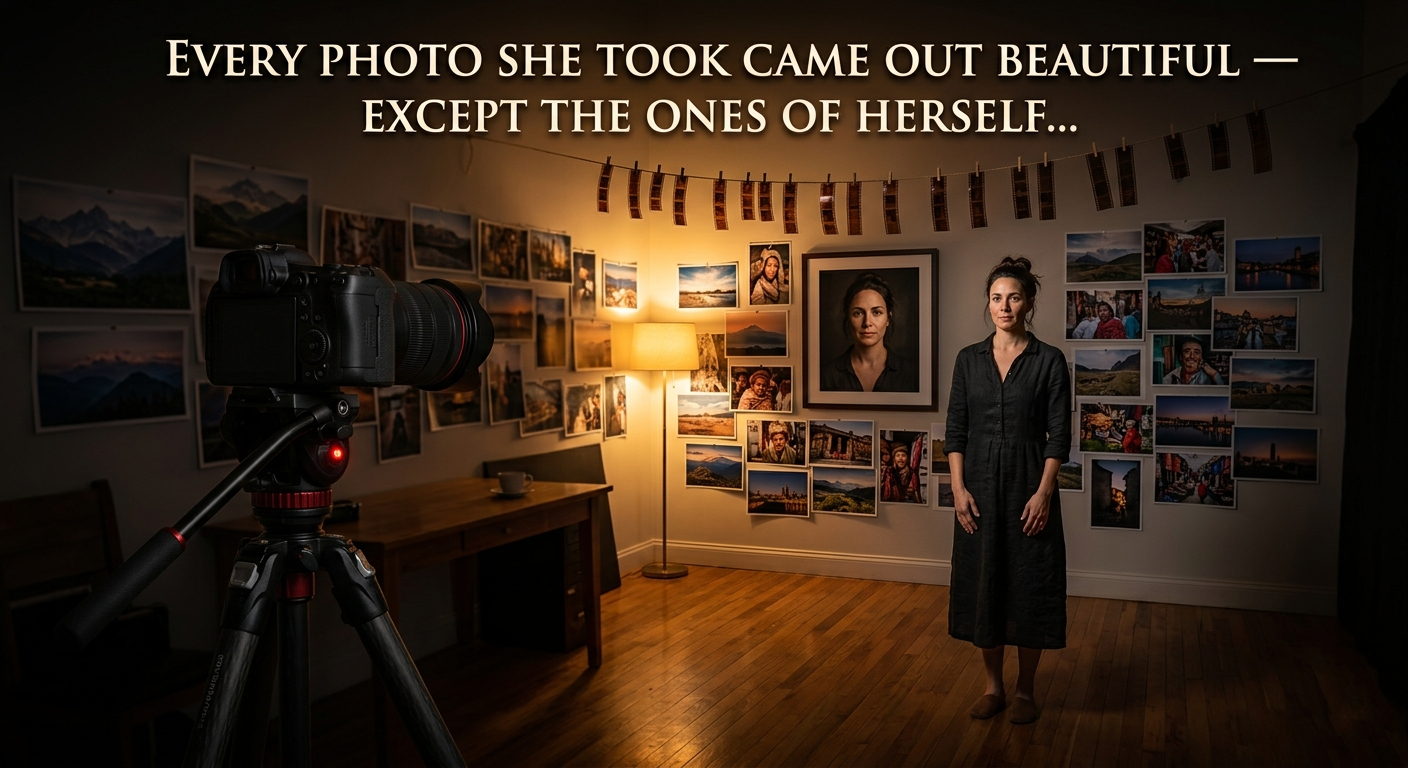
Every Photo She Took Came Out Beautiful — Except the Ones of Herself, Which Always Showed Someone She Didn’t Recognize !
Once there was a woman named Iris who saw the world more clearly through a lens than she did with her own eyes.
This is not as uncommon as it sounds. There are people for whom the act of framing — of choosing what enters the rectangle and what stays outside it, of deciding where the light falls and what the shadow says — is less a technical skill than a native language. The first language. The one that was there before words, before the names of things, before the long education of becoming a person in the world.
Iris had been this way since childhood. Her first camera was a disposable one, bought at a gas station with birthday money when she was nine, and she had used all twenty-seven exposures in a single afternoon — not on the things children usually photograph, birthdays and pets and family gathered at tables, but on the underside of a leaf, a crack in a sidewalk where a weed had pushed through, her grandmother’s hands resting on a kitchen table, the specific quality of light in a hallway at four in the afternoon.
When the prints came back from the drugstore, her mother had stood at the counter looking through them for a long time without saying anything.
Then she had said: where did you learn to do this?
Iris had not known how to answer. She had not learned it anywhere. It was simply the way she saw.
She became a photographer in the way that people become the thing they were always going to be — not by deciding but by following the path of least resistance through themselves, by doing the thing that cost the least effort and gave the most return, until one day you look up and find you have traveled very far in one direction and the direction has a name.
She photographed everything. Landscapes, cities, strangers on streets, the interiors of old buildings, the faces of people at significant moments — grief and joy and love and the complicated in-between states that have no single name but that the camera, somehow, could hold all at once.
She was extraordinary.
Not technically merely — though she was technically precise, having spent years learning the instrument the way a musician learns their instrument, inside out, until the mechanics became invisible and only the music remained. She was extraordinary in the way that matters more than technique, which is that her photographs were true. Not accurate — true. There is a difference.
Accurate photographs record what was present. True photographs record what was real, which is not always the same thing, and requires something beyond equipment and training to see.
People wept at her photographs. Not because they were sad, necessarily — though some were — but because they recognized something in them. The feeling of being seen by someone who understood not just what you looked like but what it cost you to look like it.
She exhibited in galleries. She published three books. She was reviewed in publications that use words like luminous and unflinching and necessary, and the words were deserved, and she was grateful for them, and they did not touch the thing she could not talk about.
The thing she could not talk about was this:
Every photograph she took of herself came out wrong.
Not technically wrong — exposure, focus, composition, all of it correct, all of it exactly as she had set it. Wrong in another way. A way she had no language for and had spent fifteen years trying to develop language for and had failed.
The person in her self-portraits was not her.
Or — not her in any way she recognized. Not a distortion, not a funhouse version, not the ordinary estrangement of seeing your own face in a photograph and finding it less familiar than the mirror shows it, which is common and has to do with reversal and is not what Iris meant.
What Iris meant was that the person in her photographs was someone else entirely.
A woman who looked nothing like Iris — or rather, who looked exactly like Iris in every measurable way, same face same hair same posture same clothes — but who was inhabited differently. Who carried herself differently. Who looked out from the photograph with an expression that Iris had never seen in any mirror, had never felt on her own face, had never believed her own face was capable of.
The expression was — she had thought about this for fifteen years, had turned it over and approached it from every angle available to her, and had arrived at this — the expression was the face of someone who knows exactly who they are and is completely at peace with it.
Not happy, necessarily. Not without complexity or shadow. But settled. Rooted. Present in themselves with a completeness that Iris — who was present in everything and everyone else with extraordinary fidelity — had never managed to be present in herself.
She deleted the photographs.
Every time, after looking at them for as long as she could bear — which was usually not long, because looking at them produced a feeling she could not name, somewhere between recognition and grief, between longing and terror — she deleted them.
She told herself it was a technical error she had not yet diagnosed. A quirk of certain lighting conditions. A psychological phenomenon — the uncanny valley of self-perception, the brain’s refusal to fully accept the image of the self. She read about it. She found partial explanations that satisfied her intellectually and touched nothing real.
She stopped taking self-portraits.
For seven years she did not photograph herself at all. She was in the work constantly — her eye was in every photograph, her sensibility, her specific and unrepeatable way of seeing — but her face was nowhere. She had curated herself out of her own record.
She thought this was fine.
She thought this was professional, even — she was not the subject, she was the witness, the medium through which the world’s images passed into permanence. That was the correct arrangement. That was the one she had always preferred.
It was fine.
It was fine until the morning she was photographing a young woman in a studio in the city — a portrait commission, a twenty-third birthday gift from the young woman’s parents — and she was moving around the subject the way she always did, finding the angle, and she saw the young woman’s face in the viewfinder at the exact moment the young woman forgot she was being photographed.
The forgetting showed.
The face that appeared in the viewfinder when the young woman forgot was — extraordinary. Open in a way that the careful posed face had not been. Inhabited in the way Iris had spent fifteen years seeing in her own photographs and never in her mirror.
Iris took the shot.
She took twelve more, fast, before the young woman remembered and reassembled herself.
Then she lowered the camera.
She stood in the middle of the studio, and the young woman said something — asking if everything was all right — and Iris said yes, yes everything was fine, just a moment, and she stood there holding her camera and feeling something arrive in her the way weather arrives, from a long way off, announced first by a change in the air before the thing itself is visible.
She understood something.
Not yet fully. Not yet in words. But the beginning of something — the first thread of it — that she held carefully and did not pull.
She went home that night and she sat at her editing desk and she opened the files from the day and she looked at the young woman’s face — the forgotten face, the inhabited face, the face of someone who had momentarily stopped performing themselves — for a very long time.
Then, without entirely knowing why, she set up her camera at the other end of the room.
She set the timer. Ten seconds. She stood in front of the lens.
She did not pose.
She did not arrange her face or her body or the quality of her presence. She simply stood there, and she did something she had not done in fifteen years, which was to forget, briefly and effortfully and at first unsuccessfully, that she was being photographed.
She stood there for a long time.
The shutter fired.
She went to the desk.
She opened the file.
She looked at the photograph for a long time without speaking, without moving, without doing anything except looking.
The woman in the photograph was the stranger.
The same stranger she had been seeing for fifteen years — same settled quality, same rooted presence, same face of someone who knows exactly who they are.
But this time Iris looked longer.
She had always deleted quickly — looked as long as she could stand and then removed the image before it could do whatever she was afraid it was going to do. This time she did not delete. She sat with the discomfort of looking, the specific vertigo of seeing a face you know is yours wearing an expression you have never felt yourself wear, and she breathed through it, and she kept looking.
And slowly — the way the eye adjusts to darkness, slowly and then completely — she began to see.
The stranger was not someone else.
The stranger was her.
Not the Iris who moved through the world carefully, who had learned since childhood to be the observer and not the observed, who had built her entire life around the principle that she was the one who held the camera and not the one who stood before it. Not the Iris who had photographed a thousand faces with full attention and turned the lens on herself only reluctantly, hastily, then not at all.
The other one. The earlier one. The one who had existed before the long careful education of making herself small enough to disappear behind the work.
The stranger in the photographs was the Iris who had stood at a drugstore counter at age nine watching her mother look at photographs of a leaf’s underside and a crack in a sidewalk and an old woman’s hands and feel — something. Something that mattered. The Iris who had understood in that moment that she had the ability to make people feel seen. Who had been, in that moment, incandescently, uncomplicated proud.
Before she learned to be only the instrument.
Before she learned that the instrument does not get to be seen — that you cannot be both the eye and the face, both the witness and the witnessed, both the one who shows and the one who is shown.
She had learned this wrong.
She sat at her desk for a very long time.
Outside her window the city went about its nighttime self — lights, movement, the distant sound of someone somewhere having an ordinary evening. Iris sat in the lamplight of her studio with the photograph on her screen, looking at a woman she had been deleting for fifteen years.
She picked up her camera.
She went back to the other end of the room.
She set the timer.
She stood in front of the lens.
And this time she did not try to forget she was being photographed.
She did the opposite.
She looked directly into the lens — not performing, not arranging, not constructing the version of herself she was willing to present — and she said, silently, in the deep private language of a person speaking to their own reflection: I see you. I have been seeing you for fifteen years and deleting you for fifteen years and you have been growing in the deleted files this whole time and I am sorry it took this long. I am here now. I am looking.
The shutter fired.
She went to the desk.
She opened the file.
She looked at the photograph.
The stranger was there — same settled face, same rooted presence. But this time something was different. This time there was something in the stranger’s eyes that had not been there in fifteen years of photographs.
Recognition.
Not of the camera. Not of the room or the lamplight or the city outside the window.
Of Iris.
The stranger in the photograph recognized her.
Was looking back at her across the fifteen years as if to say: yes. Finally. I have been here the whole time. I am not someone else. I am the part of you that sees — not only what is outside you but what is inside, not only other people’s faces but your own, not only the world’s beauty but yours. I am the eye that has been trying to turn itself around this whole time, and you have been pointing me everywhere except at myself, and I have been patient because I knew you would arrive here eventually, because you are very good at eventually arriving at the truth of things, even the ones that take the longest.
Iris sat at her desk until the sky began to lighten.
Then she opened a new file.
She titled it: Self. Year One.
She began to edit.
She kept every photograph. She did not delete a single one.
In the months that followed, she began a new body of work — the first work she had ever made that was about herself. Not confessionally, not navel-gazingly, not in the way of someone who has mistaken personal experience for universal subject matter. But honestly. With the same full attention she had always given to other people’s faces turned now, carefully and with enormous effort, on her own.
She photographed herself in ordinary moments. In the early morning before her face had been arranged for the world. After difficult conversations. Laughing. Tired. Uncertain. Present.
The stranger appeared in all of them.
But the stranger was becoming less strange.
The more she looked, the more familiar the face became — the more the settled quality, the rooted presence, the expression of someone who knows who they are began to feel not like someone else’s possession but like something she was growing toward. Something she was practicing into being, one kept photograph at a time.
She exhibited the work two years later.
She called the exhibition: The Woman in the Photographs.
In the catalog essay she wrote about it plainly, in the way she did everything — without ornament, without performance, with only the truth of the thing and the words required to carry it:
For fifteen years I photographed everything except myself, and told myself this was professionalism. It was not professionalism. It was fear. The specific fear of turning the full force of your attention on yourself and finding — not nothing, which would be its own kind of answer — but someone you do not recognize. Someone who seems to know things about you that you have not yet been told.
What I eventually understood is that the stranger in my photographs was not a stranger. She was the self that exists before we edit it. Before we decide which version of ourselves is acceptable for public consumption and quietly delete the rest.
I had been deleting her for fifteen years.
This work is the attempt to keep her.
To look at her directly and not flinch.
To say: I see you. And I am not going anywhere.
People stood in the gallery for a long time in front of her self-portraits.
They recognized something in them.
Of course they did.
They recognized what it looks like when someone finally stops running from their own face and turns around.
It looks like courage.
It looks like coming home.
It looks, if you stand in front of it long enough, exactly like yourself.
The end.