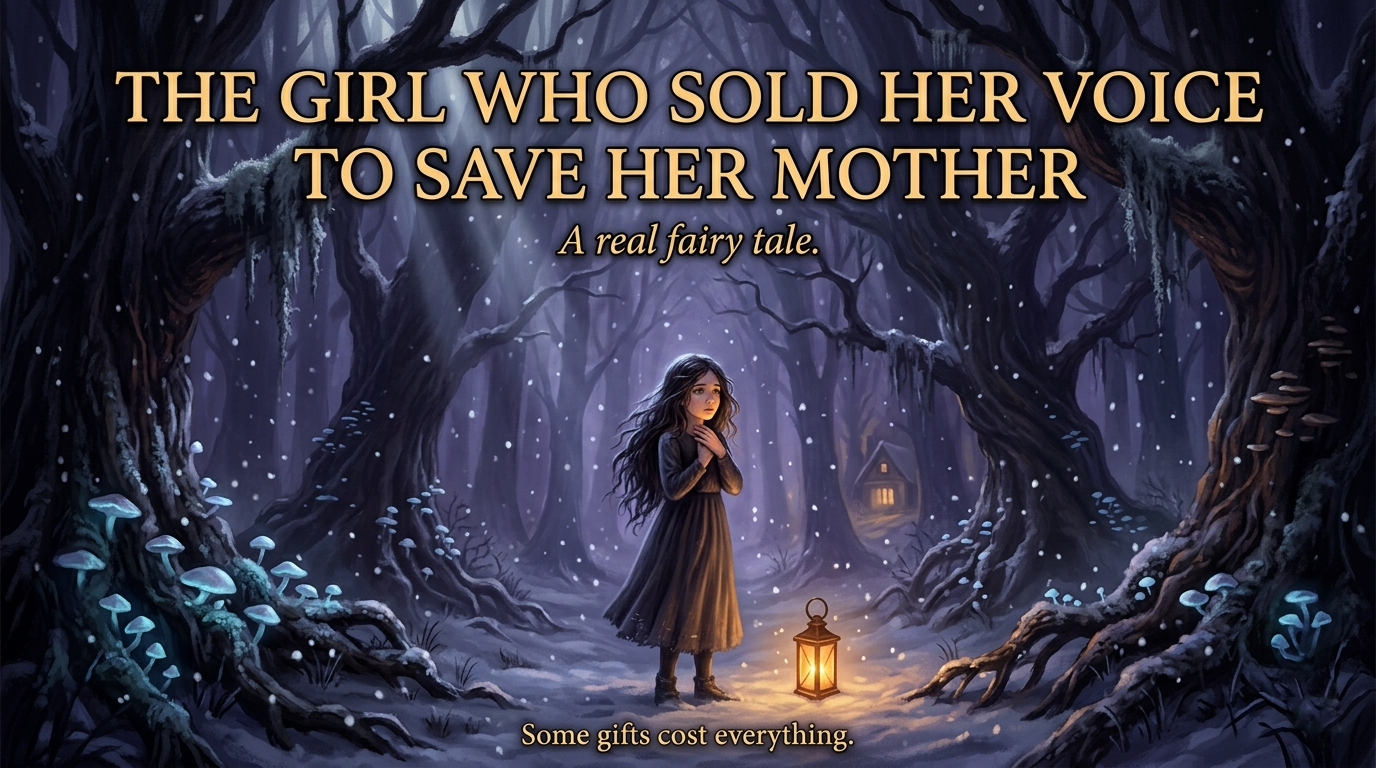
The Girl Who Sold Her Voice to Save Her Mother !
Once, in a village tucked between two sleeping mountains, there lived a girl named Elara whose voice was not entirely of this world.
When she sang, bread rose faster in the ovens. Sick horses stood up. Old men who had forgotten the faces of their wives suddenly remembered and wept with joy. The villagers said God had pressed His thumb gently against her throat when she was born and left something golden behind.
Her mother, Maren, was the only person Elara never sang for.
“Save it for the world,” Maren always said, cupping her daughter’s face.
“Your voice is too big to waste on just one woman.”
But Elara would have given every note, every breath, every trembling syllable — all of it — for her mother alone.
And one bitter November, she had to.
The sickness came quickly. It moved through Maren like a tide pulling everything out to sea. The village healer shook her head. The traveling doctor shook his. By the third week, Maren’s eyes had gone distant, as though she was already looking at something just beyond the room, something warm and very far away.
Elara had heard stories of the witch who lived where the forest went black — the one they called Old Sable. People said she could pull the sickness out of a body like a splinter. People also said she took something in return. Always something precious. Always something that could not be returned.
Elara went on the coldest night of the year.
The witch’s house smelled of pine smoke and copper. Old Sable herself was not frightening — not exactly. She was small and ancient, with eyes the color of creek water, and she looked at Elara the way a jeweler looks at a stone.
“I know what you want,” Old Sable said before Elara had spoken a single word. “And I know what I want in return.”
“Name it,” Elara said.
“Your voice. Every note. Every word. Every whisper. From this night forward, you will be silent as snow.” Old Sable tilted her head. “Do you still want to trade?”
Elara thought of her mother’s face. Of the way Maren laughed when Elara sang silly songs about the chickens. Of the way she clapped her hands like a child at the market, eyes bright, so proud, always so proud.
“Yes,” Elara said. And it was the last word she ever spoke.
She felt it leave her — not painfully, but completely. Like a candle snuffed. The silence that replaced it was enormous and absolute.
She walked home through the snow without a sound, not even her footsteps seemed to make noise now. When she opened the cottage door, her mother was sitting up in bed.
Maren’s color had returned. Her eyes were clear. She looked at her daughter standing in the doorway, snow in her hair, tears streaming silently down her face, and something in Maren’s expression shifted — some maternal knowing that lives below words and reason.
“Elara,” she whispered. “What did you do?”
Elara smiled. She crossed the room. She sat beside her mother and took her hands. Then she shook her head slowly — meaning: nothing. Meaning: don’t worry. Meaning: it doesn’t matter. Meaning: you are alive and that is everything.
Maren pulled her daughter close and wept into her hair.
In the months that followed, the village noticed. Of course they noticed. Elara moved through her days in perfect silence — answering in gestures and notes written on scraps of paper, her smile doing the work her voice once did. People mourned the loss loudly. Musicians came from other towns, hoping she would sing just once. She never did.
But something unexpected happened.
Because Elara could no longer speak, she listened — with every part of herself, with the total attention of someone who knew what words cost. She listened to the baker’s grief over his dead son. She listened to the miller’s wife talk about loneliness. She listened to children tell nonsense stories about frogs and cloud dragons. She looked at each person as though they were the most interesting creature she had ever encountered.
And people — strange, hungry, overlooked people — began to feel it. The gift she had lost had somehow transformed into something else. Something quieter and, some said, even more powerful.
Maren lived twelve more years. Strong years. Years full of laughter and garden mornings and grandchildren from Elara’s younger brother who visited every harvest. On the night Maren finally went — peacefully, in her sleep, her hand in Elara’s — Elara climbed the hill behind the village alone.
She sat in the dark and opened her mouth.
Nothing came out. Of course nothing came out.
But the wind, that night, sounded like it was singing.
And every bird in the sleeping forest went quiet — the way they always had when Elara’s voice rose up — as though they were listening to something beautiful that only they could hear.
The end.