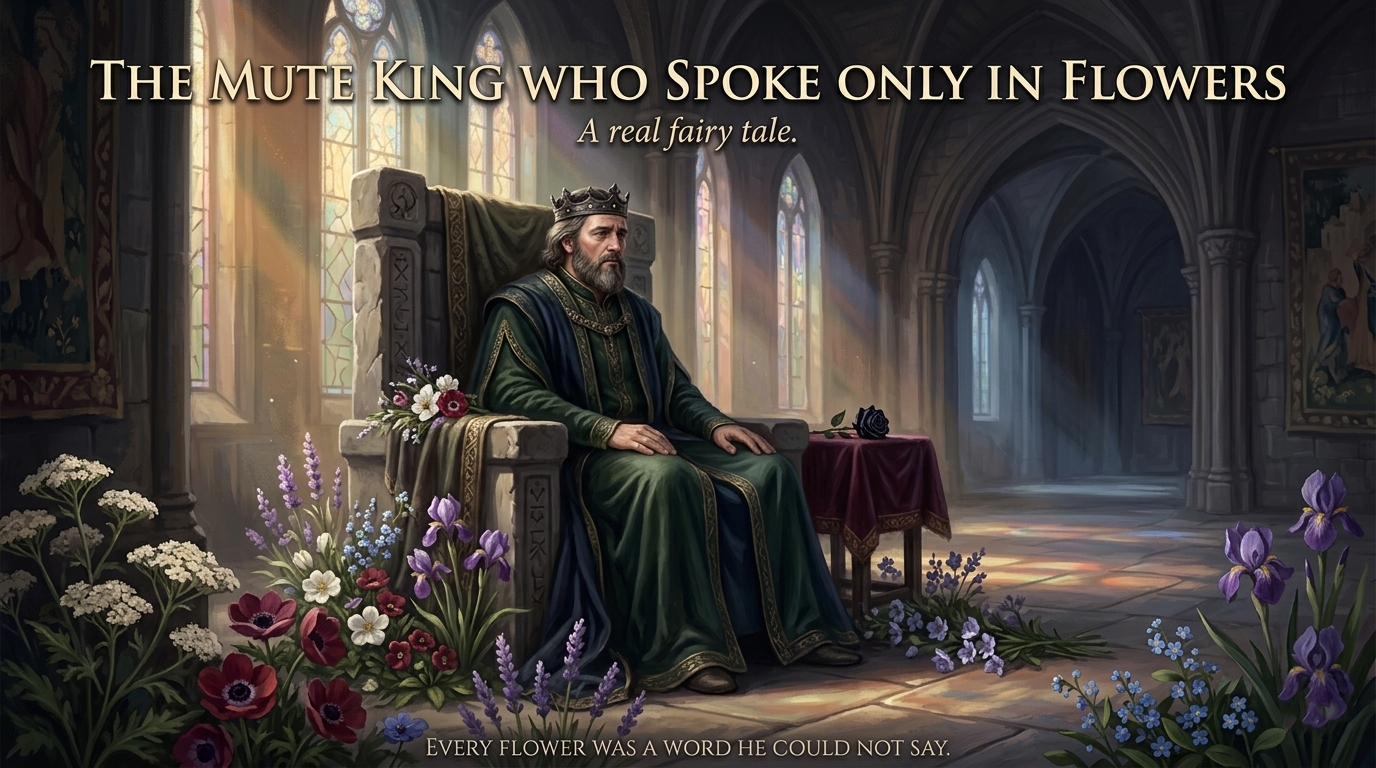
The Mute King Who Spoke Only in Flowers !
The kingdom of Vaelorn had been ruled for thirty years by a king who had never spoken a single word.
Not because he could not. The healers had examined him thoroughly. His throat was strong, his lungs deep, his tongue perfectly formed. The silence was a choice — though no one alive knew when he had made it, or why. He had arrived at the throne at seventeen, already quiet, already carrying the stillness of someone who had decided something irrevocable about the world.
His name was King Aldric. And he spoke only in flowers.
Every decree, every judgment, every private feeling — he expressed through blooms chosen with extraordinary care and laid on a velvet cloth for his royal interpreter to read. The interpreter was an old woman named Thessaly who had served his father and his father’s father, and she had spent fifty years learning the language of petals the way others learn the language of law.
White yarrow on the cloth meant peace had been granted.
Red anemone meant war was coming and preparations should begin.
A single forget-me-not, laid alone, meant he was thinking of the dead.
The court had learned to read the room by watching what Thessaly did after she examined the flowers. If she smiled, it was good news. If she pressed her lips together, it was complicated news. If she left the room quickly without speaking, it was the kind of news that required a moment to carry.
Aldric ruled with extraordinary fairness. His judgments were slow and considered — he could not be rushed into speech, after all — and the extra time it took to render them meant that he had usually seen five angles of a problem that faster-talking kings would have missed. Vaelorn thrived. Its roads were good, its granaries full, its borders quiet.
But the king was profoundly alone.
He had a daughter, Princess Sera, who had grown up reading flowers the way other children grew up reading books. She knew that peonies meant he was proud of her. That chamomile meant he was worried. That when he left a single red tulip outside her bedroom door on the morning of her examinations, it meant he believed in her completely.
She loved him with the whole complicated love of a child who has learned to translate a parent’s heart from a distance.
When Sera was nineteen, a young man came to court from the eastern provinces — a musician named Corvin, who had the misfortune of being brilliant and the fortune of being kind. He came to play for the king and ended up staying for Sera, and she ended up staying up late thinking about him, which was inconvenient and wonderful.
He asked her once, in the garden, what her father was really like.
She thought for a long moment.
“He is the loudest person I have ever known,” she said. “You just have to learn to listen differently.”
Corvin looked at her. “Teach me.”
So she did. She taught him that morning glories meant hope tempered by uncertainty. That lavender meant gratitude, deep and old. That iris — purple iris specifically — meant a man was carrying something he did not know how to put down.
The king always had purple iris on the table in his private study.
One autumn, Thessaly died in her sleep. Peacefully, the servants said. Her hands folded. Her face relaxed. The king stood at her bedside for a long time, and when he finally turned to go, he left a single white chrysanthemum on her pillow.
In the old flower language — the very oldest, which Thessaly had taught Sera as a child — white chrysanthemum meant: you were the truest friend I ever had.
Sera wept. But she dried her eyes and took Thessaly’s place.
She was not as practiced. She made mistakes in the early weeks, misreading a sprig of rosemary as remembrance when her father had meant it as a warning — the two meanings living so close together in that small grey herb. But Aldric was patient. He would wait while she puzzled over a bloom, turning it slowly in her fingers, and when understanding finally crossed her face, something in his eyes would ease.
They grew close in a way they had not been able to when Thessaly stood between them.
Then one morning in late winter, Sera entered the throne room and found her father sitting very still, his hands folded in his lap. On the velvet cloth before him lay a single flower.
A black rose.
Sera had never seen one come from the royal greenhouse. She stood very still and looked at it for a long time. Black rose. In the oldest language, in the deepest meaning.
I am coming to my end. Do not grieve too long. I have been happy.
She left the room quickly. She walked to the garden. She sat under the bare oak tree where she had played as a child. And she wept for three days — not all at once, but in small pieces, spread across meals and sleepless nights and quiet moments between meetings — before she could bring herself to gather the council and tell them what the king had said.
Aldric died on the first morning of spring. True to some private arrangement he seemed to have made with the world.
His chamber, when they entered it after, was filled with flowers. Every surface covered. The healers had never seen anything like it — he must have been arranging them for weeks. And Sera, moving slowly through the room reading each cluster and sprig and bloom, realized what he had done.
He had written her a letter. The longest letter she had ever received.
Arranged in flowers across every table and windowsill and bedpost. It took her the whole day to read it.
It said: I was afraid, when you were born, that I would not know how to love you without words. I was wrong. You taught me that love does not live in language. It lives in attention. In the turning toward. In the staying. You were the bravest thing I ever did, and the best. Tell Corvin he has my blessing. I knew about him from the beginning — a single red camellia on his lapel the first day he arrived told me everything I needed to know about his intentions. I approved immediately. I simply enjoyed watching you both figure it out.
Take care of Vaelorn. Take care of yourself. And when you miss me — which I hope you will, a little, not too much — put flowers on the windowsill. I will know.
Your father.
Sera stood in the middle of the room for a very long time.
Then she went to the greenhouse. She chose the most perfect purple iris she could find — the one her father had always kept for himself, the one that meant carrying something too heavy to name — and she put it on the windowsill of her own chamber.
And next to it, she placed a small white chrysanthemum.
You were the truest friend I ever had.
Outside, the first bees of spring were beginning to arrive.
The end.