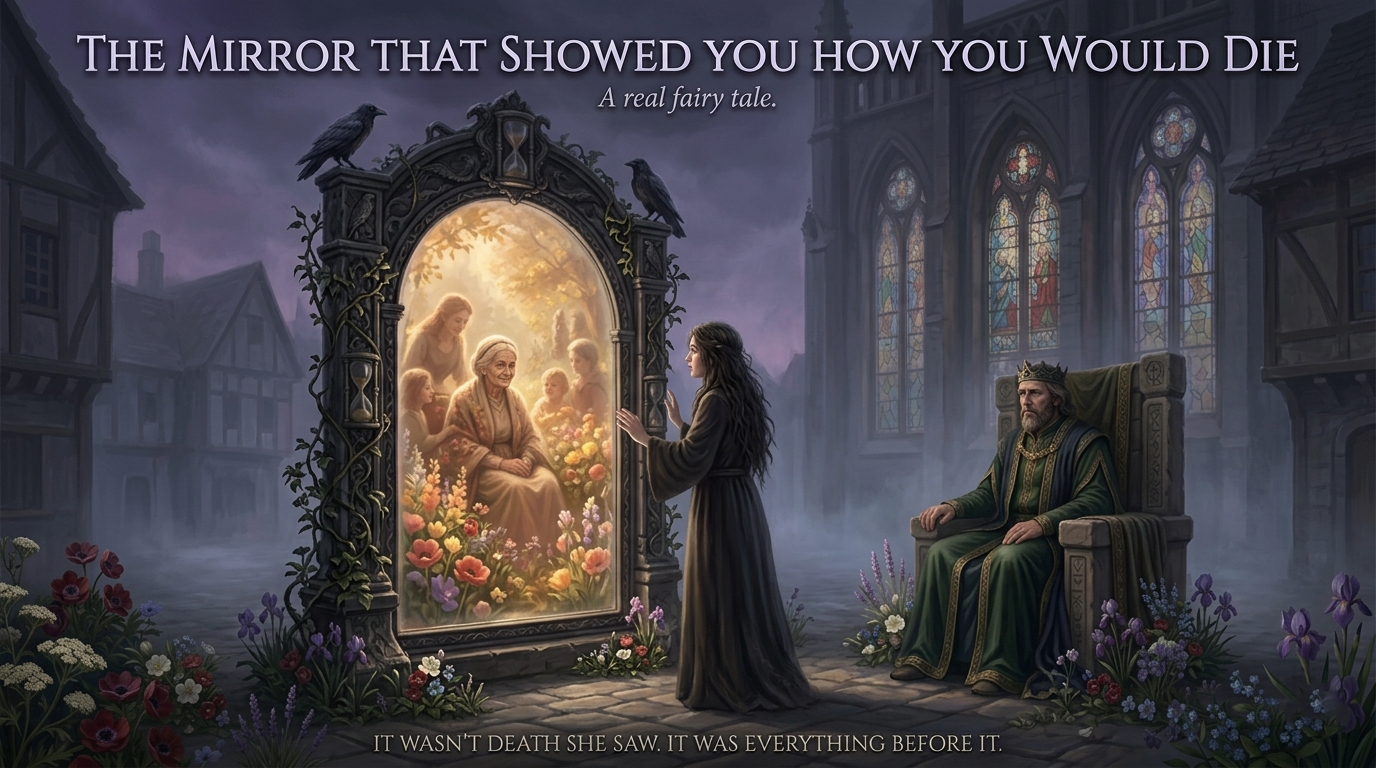
The Mirror That Showed You How You Would Die !
The mirror arrived the way all dangerous things arrive — quietly, wrapped in ordinary cloth, carried by someone who seemed perfectly harmless.
A peddler had sold it to Old Maret for three copper coins and a warm meal on a cold night. He had not warned her about it. Perhaps he did not know.
Perhaps he knew very well and needed the meal badly enough not to care.
Either way, Old Maret hung it in her cottage near the window where the morning light came in soft and grey, and on the third day she looked into it and saw herself lying still in her chair with a cup of tea gone cold beside her hand.
She sat down in that same chair immediately. She folded her hands.
She waited.
By evening she was gone, exactly as the mirror had shown. The tea went cold beside her. Her face was peaceful. The neighbors who found her said she looked like a woman who had simply finished something and set it down.
They should have buried the mirror with her. Instead they argued about it, and in the arguing someone brought it to the village square, and by nightfall half the village knew what it did, and by morning there was a line.
Some people refused to look. The blacksmith, who was a practical man, said he didn’t need to know — he needed to work, and the two things had nothing to do with each other. The priest said looking was a sin against providence. The baker looked immediately, before anyone could talk him out of it, and came away white-faced and would not speak about what he had seen for three full days. When he finally spoke, he said only: “It’s not violent. I was relieved.” He would say nothing more.
The mayor looked and then quietly began spending more time with his estranged son. People noticed but said nothing.
The schoolteacher refused twice and then looked on the third day and wept quietly on the walk home. She was at school the next morning exactly on time, her eyes clear, her voice steady.
And then there was Mira.
Mira was seventeen, the miller’s daughter, and she was not afraid of the mirror for the reason everyone expected. She wasn’t brave. She wasn’t reckless. She was simply already living with a particular terror — the fear that her life would amount to nothing, that she would slip through the world leaving no mark, that she would be forgotten before she was even fully gone.
That fear, she had discovered, was worse than most others.
She went to the mirror on the fifth day, when the line had thinned. She stood before it alone in the early morning, the village still sleeping, mist coming up from the river.
She looked.
For a long moment there was only her own face — young, serious, a little tired. Then the surface shifted, like water after a stone, and she saw it.
She was old. Enormously, beautifully old — the kind of old that takes decades of living to build, the kind that settles into a face like furniture settles into a beloved room. She was sitting in a garden she did not recognize yet but somehow knew she would love. Around her were people — many people — and they were laughing and talking and some of them were crying and all of them were looking at her with the specific tenderness reserved for those we cannot imagine the world without.
She was holding someone’s hand. A child’s hand. Small and certain in hers.
She was smiling.
And then she was still.
Mira stepped back from the mirror. She stood in the cool morning air for a very long time.
She had expected fear. She had expected the cold shock of seeing something final and inevitable. Instead she felt something she could not immediately name — a feeling like setting down a very heavy bag you have carried so long you forgot it was there.
She walked home slowly. She ate breakfast with her father, who was already up and floury-handed, and she watched him move around the kitchen with sudden extraordinary attention — the way his shoulders moved, the particular sound of his laugh, the small ritual of how he poured his tea.
She had never looked at him so carefully before.
It occurred to her, walking to her work that morning, that the mirror had not shown her death at all.
It had shown her that she would be loved. That she would grow old. That she would sit in a garden someday with people around her who could not imagine the world without her. The dying was the smallest part of the image. The rest — the long middle, the whole enormous living stretch of it — was implied. Promised, even.
The terror of an empty life that had lived in her chest for as long as she could remember quietly moved out that morning. It did not happen all at once. But it began then.
She told no one what she had seen. It felt private in the way that prayers feel private — not secret, exactly, but belonging to her.
The mirror stayed in the village square for seven more days. The peddler returned on the eighth day, inexplicably, as though called. He wrapped it again in its ordinary cloth without a word. He walked away down the south road.
No one followed him.
No one ever saw the mirror again.
But things changed in that village in the months and years that followed, in ways that were hard to trace and impossible to fully explain. The blacksmith started teaching his apprentice with more patience. The mayor’s son came to dinner every Sunday and stayed late. The baker made his bread more carefully than before, with a kind of reverence for small things.
And Mira — Mira grew. She grew toward people. She grew toward work that mattered. She grew toward a garden she was slowly, season by season, learning to love.
She grew old, beautifully old, the way the mirror had promised.
And on the last morning, in the garden, with the hand of a child small and certain in hers, she looked around at all the faces tilted toward her like flowers toward the light, and she thought:
So this is what it was all building toward. This exactly. Every hard morning. Every doubt. Every year I was afraid I was wasting. It was all becoming this.
She smiled.
She let go.
The garden went on blooming long after she was still.
The end.