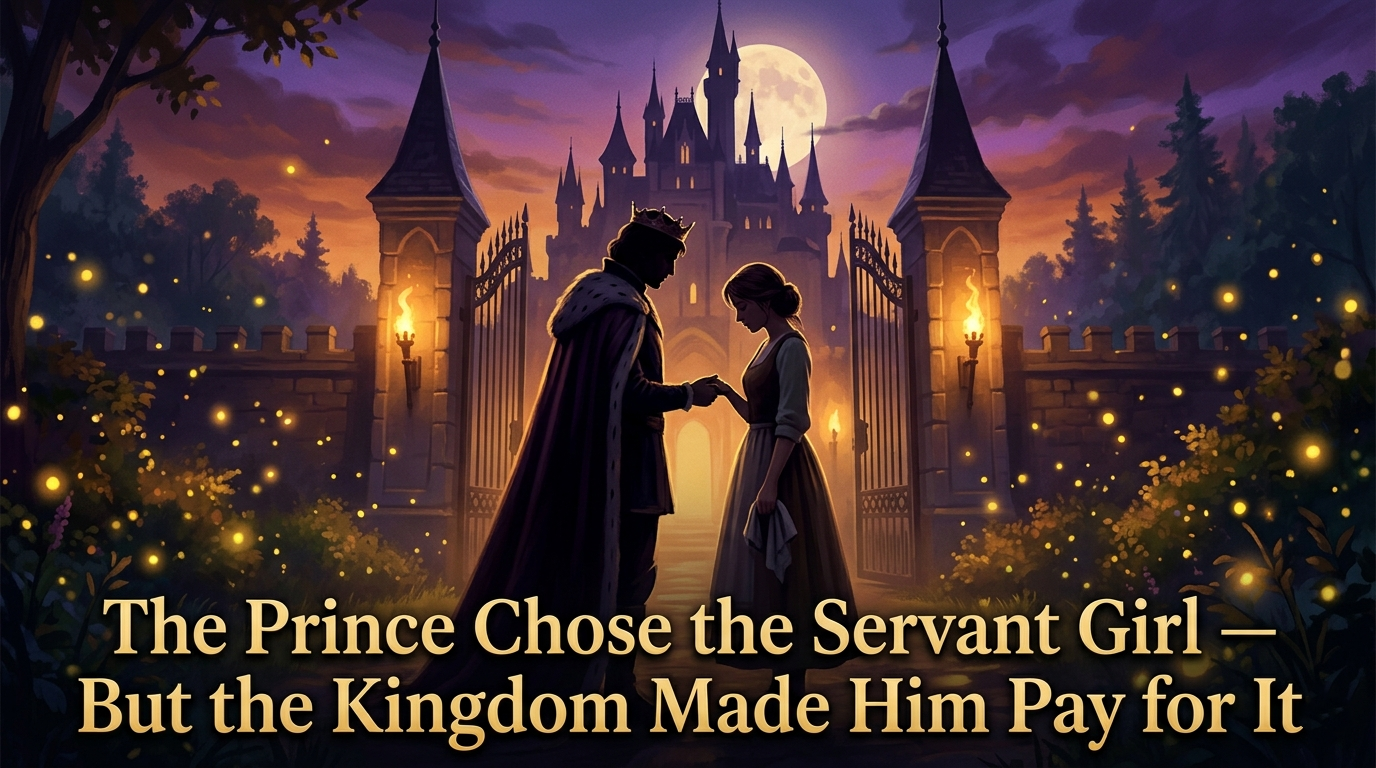
The Prince Chose the Servant Girl — But the Kingdom Made Him Pay for It !
Once upon a time, in the Kingdom of Eldenmere, there lived a prince named Caelan — tall, golden-haired, and destined by birth for greatness he never asked for.
The palace was vast and cold, filled with marble floors that echoed loneliness, and courtiers who smiled with their mouths but watched with hungry eyes. Caelan had everything a prince could want — except anything real.
Her name was Mira.
She came to the palace at fourteen, a farmer’s daughter from the eastern fields, carrying nothing but a small cloth bag and the quiet dignity of someone who had always known hardship. She swept the grand halls, polished the silver, and sang softly to herself when she thought no one could hear.
Caelan heard her.
At first, it was only glances — stolen across crowded rooms, brief and burning. Then it became words. She spoke to him plainly, without flattery or fear, the way no one else in the palace ever did. She told him when he was wrong. She laughed at his terrible jokes. She asked him, once, what he actually wanted from his life — and he had no answer, because no one had ever asked before.
He fell in love the way a candle falls into darkness. Completely, and without going back.
When Caelan announced before the Royal Court that he intended to make Mira his wife, the silence that followed was the loudest sound he had ever heard.
Then the kingdom erupted.
The nobles called it an insult. A servant girl on the throne of Eldenmere? They laughed. Then they plotted.
The King — his own father — called it a disgrace. He gave Caelan a choice in private, behind closed doors, his voice like cold iron: Abandon the girl, or abandon the crown.
Caelan chose Mira.
Three days later, he was stripped of his title in a public ceremony designed to humiliate. They took his royal seal. His horse. His chambers. They escorted him to the palace gates like a stranger.
Mira stood beside him, trembling but straight-backed, her chin raised even as tears carved silent lines down her face.
The crowd gathered outside the gates was not kind.
They lived in a cottage at the edge of the Aldmere Woods — small, drafty, and wonderful in the way that only earned things can be wonderful. Caelan learned to chop wood. Mira taught him to bake bread. He was terrible at it for a long time. She never let him forget.
They were poor. They were happy. They were watched.
The kingdom sent word, through whispers and messengers, that Caelan could return — if he came back alone. Month after month, the offer came. Month after month, he refused.
What the kingdom did not account for was this: a man who has chosen love once, and paid for it fully, does not un-choose it for comfort.
Years passed.
The old King grew ill. The nobles who had plotted and preened turned on each other like wolves without a shepherd. Eldenmere fractured — trade collapsed, alliances crumbled, and the people, the real people, began to remember the prince who had been cast out not for cruelty or weakness, but for daring to love someone ordinary.
They came to the cottage in ones and twos at first. Then dozens. Then hundreds.
Not to beg Caelan to return to power — but to tell him what his choice had meant to them. Farmers. Servants. Craftsmen. People who had spent their whole lives being told they were background, decoration, less-than. His love for Mira had said something no royal decree ever could:
You are worth choosing.
In the end, it was not an army or a coup that changed Eldenmere.
It was a daughter.
Caelan and Mira’s firstborn — a girl named Sela, with her mother’s eyes and her father’s stubborn jaw — grew up knowing both poverty and grace. When she came of age and the fractured kingdom called for new leadership, she was ready in ways no palace-raised prince had ever been.
She understood hunger. She understood dignity. She understood that a ruler who has never scrubbed a floor cannot truly see the people who do.
Queen Sela rebuilt Eldenmere not from the top down, but from the ground up.
And in the courtyard of the palace her grandfather had cast her father from, she erected a small stone statue — not of a king or a conqueror, but of a young woman carrying a cloth bag, walking toward something unknown with her chin raised.
Beneath it, carved in simple letters:
She was worth it. She was always worth it.
Caelan and Mira never returned to the palace to live. They didn’t need to.
Every morning, in their cottage that no longer leaked, Caelan still made terrible bread. Mira still laughed. And somewhere in Eldenmere, a kingdom that had once tried to crush a love story was quietly, stubbornly, becoming worthy of one.
The end. 👑