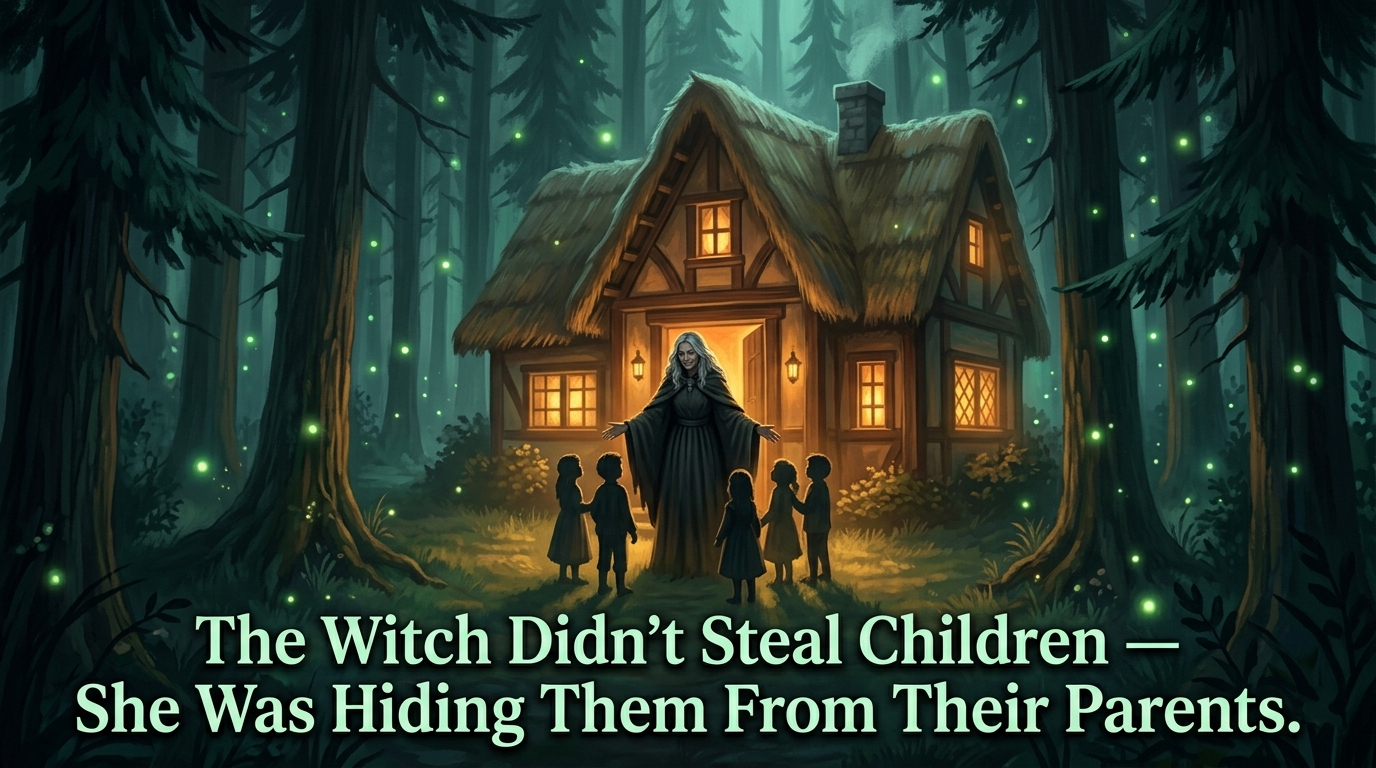
The Witch Didn’t Steal Children — She Was Hiding Them From Their Parents !
Once upon a time, deep in the Ashwood Forest where the pines grew so thick that noon looked like dusk, there lived a woman the village called Maren the Terrible.
She had silver hair she never bothered to pin, a crooked nose from a childhood fall she never bothered to explain, and a cottage so overgrown with moss and moonflower that it seemed to be slowly returning to the earth. Smoke rose from her chimney every night. Strange green light flickered in her windows.
And sometimes — not often, but sometimes — a child who had gone missing from the village would be spotted near the edge of her wood.
That, the villagers decided, was all the evidence they needed.
She steals them, they whispered over their fences. She takes them in the night. Lock your doors. Watch your children. Keep them from the Ashwood.
What the village did not know — what Maren had spent twenty years making sure they would never know — was that the children came to her.
They always came to her.
The first had been a boy named Pip, eight years old, who appeared at her door on a January night with a split lip and no shoes. He said he’d gotten lost. She didn’t ask more. She gave him bread, wrapped his feet in wool, and put him by the fire. In the morning, she asked if he wanted to go home.
He looked at the door for a long time without speaking.
She didn’t ask again.
After Pip came Wren, a girl of ten with clever hands and shadows under her eyes that no child should carry. Then twins no one had given names to — she named them Oak and Ash herself. Then a small boy called Finch who didn’t speak at all for the first three weeks, and then one morning announced that her porridge was the best thing he’d ever eaten, and never stopped talking after that.
They came in ones and twos across the years. Thin. Frightened. Wearing the particular expression of a child who has learned not to flinch visibly, because flinching only makes it worse.
Maren fed them. Taught them. Gave them beds and chores and rules — fair rules, clearly spoken, consistently kept. She let them be angry. She let them be sad. She never once raised her hand.
For many of them, it was the first safe place they had ever known.
She was careful. She moved the children when she had to, used the forest’s deep trails, kept them hidden during the seasons when search parties came through. She taught them to be quiet and still as deer.
She never told them what to call her. They chose Nana themselves, and she let them, though it made her chest ache in a way she couldn’t name.
She had no magic. The green light in her windows was just a glass bottle she’d hung there years ago, a gift from a traveler. The strange smoke from her chimney was pine resin and chamomile, because chamomile helped Wren sleep. The rumors of curses and hexes — she had started some of those herself, deliberately, because fear was a better fence than anything she could build with her hands.
The monster reputation was not an accident. It was a wall.
The trouble came, as trouble does, when one child made the mistake of being seen.
Oak — thirteen now, tall, unmistakably alive — was spotted at the forest’s edge by a merchant who recognized him from a notice posted in the village square two years prior. Missing. Reward.
By nightfall, the village had assembled. Thirty men and women with torches, walking the Ashwood road with the absolute moral certainty of people who have never once questioned their own story.
Maren met them at her gate.
She did not run. She did not hide. She stood in the torchlight with her silver hair loose and her chin level and said: You may search my house. Every room. You will find children. You will find them fed and clean and whole. And then I will ask you — each one of you — to look those children in the eye and tell them they are coming home with you.
The crowd went quiet.
What followed was not a rescue. It was a reckoning.
One by one, the children came to the door. Oak, who had come to Maren at age six with a broken wrist that had been set badly and healed crooked. Wren, who recognized three people in that crowd and went white as chalk. Finch, who hid behind Maren’s leg but did not cry, because Finch had learned a long time ago not to cry where adults could see.
Some of the parents in the crowd found their children’s eyes and looked away first.
A few did not come. There were parents in that torchlight whose children were not in the cottage — children who had gone back, tried again, built bridges from the ruins of hope. They were not there because Maren had sent them home the moment she believed it was safe enough.
She had never kept a single child who could be safely returned. Not one.
It was an old woman from the far side of the village who spoke first, into the long silence. Her name was Hilde, and she had nine grandchildren of her own, and she had come tonight because everyone else was coming, and now she stood at the front of the crowd with a torch she no longer felt like holding.
How long, Hilde said, her voice rough and quiet. How long have you been doing this?
Twenty-three years, said Maren.
Alone?
Yes.
Hilde turned to look at the crowd behind her. Then she turned back.
Well, she said. That ends tonight.
It was not a fairy-tale ending, not really. The law was complicated. Some parents contested. Some children were returned to homes that had genuinely changed — and some were not, and the fight for them took years and cost Maren more than she liked to count.
But something shifted in the village that night. Something that couldn’t be unshifted.
People began to ask different questions. To look differently at the child who was always hungry, the child who flinched, the child who never seemed to want to go home. The silence that had made Maren’s wall necessary began to crack — not all at once, not easily, but crack it did.
Maren never became beloved. She remained too strange, too sharp, too uninterested in being liked. But when she walked through the village market in her later years, people moved aside with something other than fear. Something closer to respect. And sometimes — not often, but sometimes — a parent would bring a child to her door themselves, and say I need help I don’t know how to ask for, and she would let them in, and put the kettle on, and listen.
It turned out the wall had a door in it, all along.
She had simply been the only one willing to stand at it.
Oak became a physician. Wren, an advocate for children in the courts. Finch never stopped talking — he became a schoolteacher, the kind whose students remember him for the rest of their lives.
And deep in the Ashwood, the cottage with the green bottle in the window and the smoke that smelled of pine and chamomile still stood. The door was never locked.
It never had been.
The end. 🌿