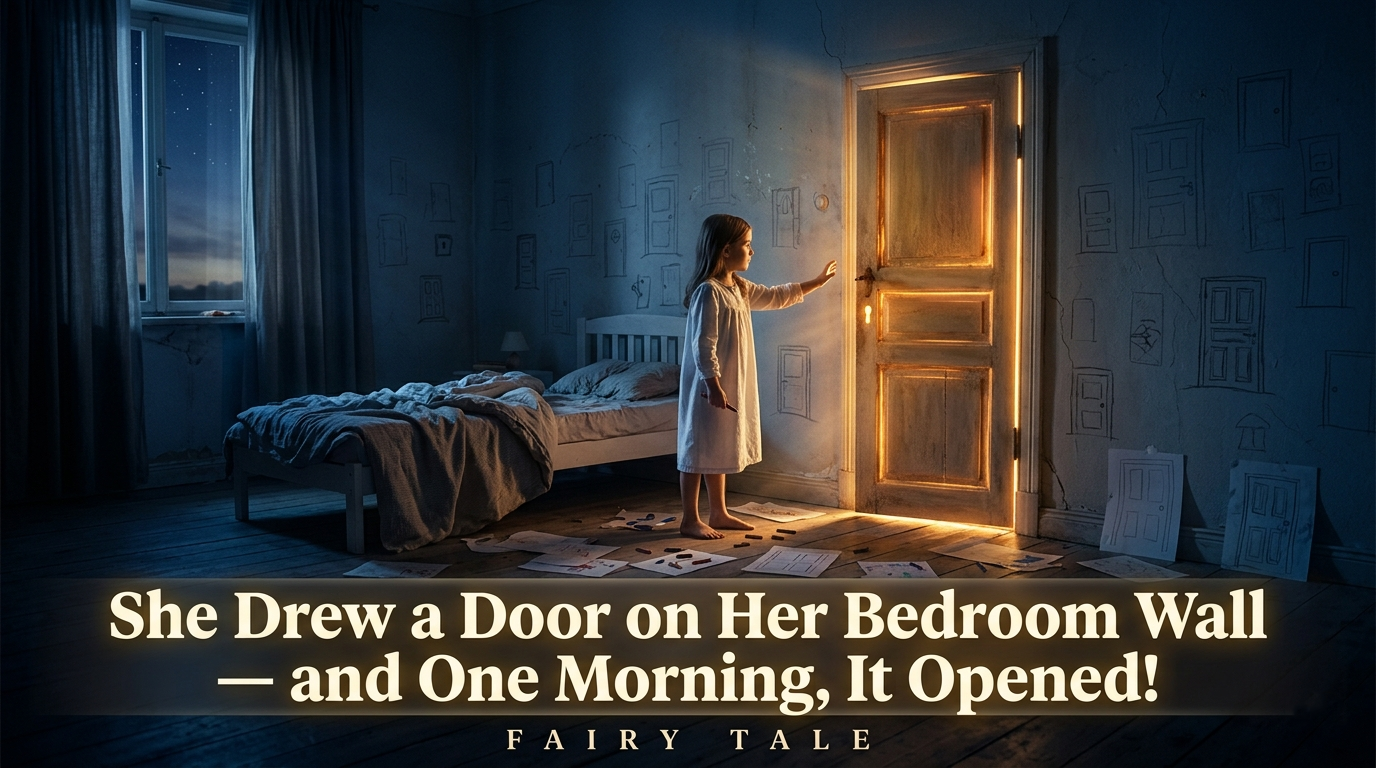
She Drew a Door on Her Bedroom Wall — and One Morning, It Opened !
Every night, before her mother turned out the light, little Wren did the same thing.
She reached under her pillow, pulled out a stubby blue crayon, and drew a door on the wall beside her bed.
It was never a very good door. The lines were wobbly. The handle was always a lopsided circle. Sometimes she added a tiny window at the top, a crooked star-shaped knocker, or two mismatched hinges. She drew it the same way every night — the same crooked rectangle, the same silly knob — until the wall above her baseboard was covered in a thousand faint ghost-doors, layered one on top of the other.
Her mother had stopped asking her to stop long ago.
“Where does it go?” her older brother Eli once asked, peering at the wall like it might bite him.
“Somewhere better,” Wren said simply.
Nobody understood what she meant. Not her mother, not Eli, not her teacher at school, not the kids who left her sitting alone at lunch. Wren was the kind of girl the world treated like a misprint — not wrong exactly, just slightly off from everything else.
But every night, she drew her door.
On the morning of her ninth birthday, Wren woke before the sun.
The room was that deep, underwater blue that belongs only to the hour before dawn — the kind of blue that makes you feel like the whole world is holding its breath.
She rolled over to look at her wall, the way she always did.
And she saw it.
A thin line of golden light.
Running along the edges of her door.
Wren sat up very slowly, the way you move when you are terrified that the wrong breath will shatter something precious. She stared. The light was warm and steady, like afternoon peeking through curtains — except there were no curtains, and it was not afternoon, and the wall was just a wall.
Except it wasn’t.
Not anymore.
Her hand reached out on its own. Her fingers found the little lopsided handle she had drawn a thousand times before — and this time, it was real. Round and smooth and faintly warm, like it had been waiting for her hand specifically.
She turned it.
The door swung open.
On the other side was a world made of early morning.
Soft golden meadows rolled out in every direction, dotted with trees that held lanterns instead of leaves. The lanterns swayed in a wind Wren couldn’t feel, and each one glowed a different color — rose and amber and the pale green of fireflies. Above it all, the sky was a deep, impossible violet, hung with stars that were just barely fading, reluctant to leave.
A path led away from the door, pressed into the grass in the shape of small bare footprints, as though someone had walked this way often and not bothered to wait.
Wren stepped through.
The door stayed open behind her, leaning against nothing, perfectly still.
She walked the path of footprints through the lantern-tree meadow, past a brook that sang softly to itself, past a hollow log where a silver fox slept with its nose tucked under its tail. She walked until the path curved up a gentle hill and she reached the top.
There, sitting on a stone bench at the crest of the hill, was an old woman.
She was the kind of old that is not sad — the kind that has simply been alive for so long that it shows up in her eyes as something almost like starlight. She wore a coat the color of midnight and held a cup of something warm in both hands, and she looked at Wren the way people look at someone they have been expecting for a very long time.
“You’re later than I thought,” the old woman said. “I’ve been drinking this tea for three years.”
“I’ve been drawing the door for three years,” Wren said.
The old woman smiled. “Yes. That’s how it works.”
The old woman’s name was Sable, and she explained things the way people explain things when they know you are the sort of child who doesn’t need to be talked down to.
This place, she said, was called the In-Between. It existed in the space between what is and what could be. Most people never found it. But some children — children who felt like misfits, children who sensed there was something just beyond the wall of ordinary life — sometimes those children found the way in.
“You can’t stay,” Sable said. “Not yet. You’re too young, and your world still needs you.”
“What does my world need me for?” Wren asked. She thought of the lunch table, the empty seat, Eli’s worried face, her mother who worked so hard and came home so tired.
Sable looked at her very seriously. “To be yourself. That’s always the answer, and it’s always the hardest one.”
She pressed something into Wren’s hand. It was a small lantern — no bigger than a locket — burning with pale gold light.
“For when your nights get very dark,” Sable said. “Come back whenever you need to. You know the way now.”
Wren came back many times over the years.
She came back the year her mother got sick. She sat with Sable on the hilltop, and sometimes they talked and sometimes they only sat in the quiet, which was its own kind of comfort.
She came back the summer she was fifteen and felt like she was made of broken glass. Sable listened, and the In-Between was patient, and Wren returned each time a little more whole.
She came back at twenty-two, the night before a great change, to stand in the lantern-tree meadow and breathe the violet air and remember who she was before the world started telling her who to be.
And when she was very old herself, and her own grandchildren climbed into bed at night, she told them this:
Draw your door.
Draw it again and again. Draw it badly, on whatever wall you have. Because the world you are longing for — the one that feels just out of reach, the one that fits the shape of who you really are — it doesn’t come to people who wait.
It comes to people who keep drawing.
On the night Wren finally stopped drawing, she did not feel sad.
She felt the warm familiar handle in her palm, the door swinging wide, the gold light on her face.
And she stepped through.
And this time, she stayed.
✦ The End ✦